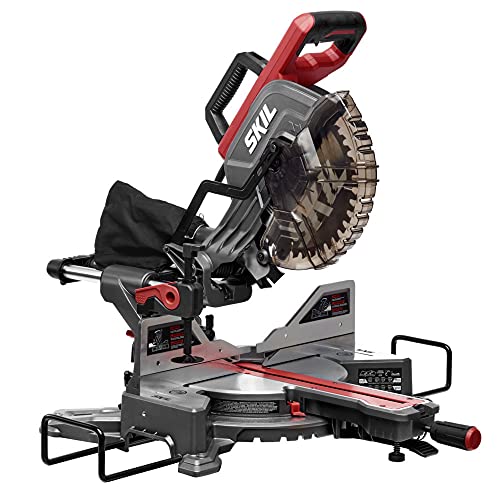
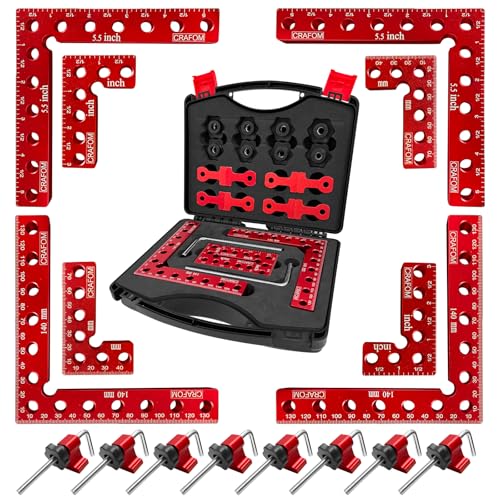
How Miter Angles Work
A miter joint is just two pieces of stock whose ends are cut at an angle so they meet to form a corner. The total turn around a closed flat shape is always 360°, and that turn is shared evenly across all the corners. Each corner is formed by two cuts (one on each piece), so each individual cut takes half of the turn at that corner.
That is where the formula comes from. For an equal-sided shape with N sides, the turn at each corner is 360 ÷ N, and each of the two cuts handles half of that: (360 ÷ N) ÷ 2 = 180 ÷ N. So a 4-sided frame is 180 ÷ 4 = 45°, a hexagon is 30°, and an octagon is 22.5°.
Frame / box: miter = 180 ÷ N
Any corner: miter = (180 − A) ÷ 2
For a single corner where you already know the inside angle A (not a full closed shape), the two pieces together have to fill that angle, so each is cut at (180 − A) ÷ 2. A standard square corner of 90° gives (180 − 90) ÷ 2 = 45°, and a wide 135° corner (like an octagon's) gives (180 − 135) ÷ 2 = 22.5°. The miter angle is always the setting off of a straight, square cut, which is how miter saws are marked.
Crown Molding Compound Angles
Crown molding does not lie flat against the wall, it tips out at the top at an angle called the spring angle (most commonly 38° or 45°, often stamped on the back of the molding). Because the molding sits at an angle, a corner needs a compound cut: the saw is both mitered (table rotated) and beveled (head tilted) at the same time.
If you cut crown flat on the saw table (face up), use these compound settings for a standard 90° corner:
| Spring Angle |
Miter Setting |
Bevel Setting |
| 38° spring | 31.6° | 33.9° |
| 45° spring | 35.3° | 30° |
Values are for a 90° corner cutting crown lying flat on the table. These are the standard, widely used settings, the 38°/45° spring angle is the angle between the back of the molding and the wall.
Flat vs. nested cutting. The simpler alternative is to cut crown nested: held upside down against the saw fence at its actual spring angle, with the ceiling edge on the table and the wall edge against the fence. Cut that way, the molding only needs a simple 45° miter (no bevel) for a 90° corner, just like a flat frame. Nested cutting is easier to set up but limited by how tall a piece your saw can hold against the fence; flat (compound) cutting handles wider crown but requires getting both the miter and bevel exactly right.
Inside vs. Outside Corners
The miter angle is the same for an inside corner and an outside corner of the same shape, what changes is the direction of the cut and which side of the piece keeps the long point.
- Outside corner (like the outside of a picture frame or a box), the long point of the miter is on the face/outside of the piece, and the cut angles back toward the inside. The two long points meet at the visible tip of the corner.
- Inside corner (like trim running into a room corner), the long point is on the back/inside, and the visible face is the short point. The cut is mirrored compared to an outside corner.
- For trim, many pros cope inside corners instead of mitering them: one piece is cut square into the corner, the second is back-cut to match its profile. Coped joints stay tight even when the corner is out of square.
Tips for Tight Miters
- Always cut a test piece. Cut two scraps at the calculated angle and dry-fit them before touching your good stock. A gap on the test joint tells you to adjust before it's expensive.
- Slightly back-bevel the cut. Shaving a hair off the back of the joint (a degree or so) guarantees the visible front faces touch first, hiding any tiny error behind the joint.
- Sand or shave to fit. If a joint is barely open, a few passes with a sanding block or a shooting board on one face closes it without recutting.
- Measure the real corner. Walls and existing frames are rarely exactly 90°. A digital angle finder plus the "Custom corner angle" mode above gets you the true miter instead of a guess.
- Clamp while the glue sets. Corner clamps or a band clamp hold the miter square and tight so it can't creep open as the glue dries.
- Keep the blade sharp and the saw square. A dull blade or a saw whose detents have drifted will throw the angle off no matter how good your math is, check the 0° and 45° detents with a known-square block.