Save your calculations offline, Get the Workshop Planner Spreadsheet ($29)

Board Feet Calculator

Calculate the board footage of lumber for your woodworking projects. Add multiple boards and estimate total cost.

⚡ Quick Answer

8 board feet is what one 8/4 hardwood board 8 feet long and 6 inches wide contains: thickness 2 in x width 6 in x length 8 ft, divided by 12. Add 15 to 20 percent extra for waste and defects. Use the calculator below for your exact numbers.

Top Lumber & Woodworking Picks

DeWalt DW735X 13" Thickness Planer

★★★★★ 4.8 (3,200+ reviews)

13" two-speed planer with extra knives and infeed/outfeed tables. Essential for milling rough lumber to final thickness.

View on Amazon

Woodpeckers Lumber Rule

★★★★☆ 4.6 (180 reviews)

Precision board foot rule for quickly calculating lumber volume at the yard. Aluminum construction lasts forever.

View on Amazon

Stanley 16' PowerLock Tape Measure

★★★★☆ 4.7 (15,000+ reviews)

Classic 16-foot tape with easy-read blade markings. Perfect for measuring lumber dimensions at the lumberyard.

View on Amazon

As an Amazon Associate, WorkshopCalc earns from qualifying purchases.

Add Lumber

Actual thickness (e.g., 1 for 4/4, 2 for 8/4)

Lumber List

No lumber added yet. Enter dimensions above and click "Add to List".

Cost Estimate (Optional)

Check local hardwood dealer prices

Results

Total Board Feet 0 BF
Total Pieces 0 boards
Estimated Cost --

Summary

Recommended Lumber Tools

Essential tools for measuring and marking lumber accurately.

As an Amazon Associate, WorkshopCalc earns from qualifying purchases. Product recommendations are selected to complement your lumber calculations.

Frequently Asked Questions

Board feet = (Thickness in inches × Width in inches × Length in feet) ÷ 12. For example, a board that's 1" thick, 6" wide, and 8' long = (1 × 6 × 8) ÷ 12 = 4 board feet.

Lumber thickness is often expressed in quarters of an inch. 4/4 (four-quarter) means 4 quarters or 1 inch thick rough. After surfacing (S2S), it's typically about 13/16" or 0.8" thick. 8/4 is 2 inches rough, about 1.75" surfaced.

Rough lumber is cheaper per board foot and gives you more control over final thickness. However, you need a jointer and planer. Surfaced lumber (S2S or S4S) costs more but is ready to use. For beginners or those without surfacing equipment, S4S is convenient.

Plan for 15-20% extra for waste, defects, and cutting errors. For complex projects with many angled cuts, consider 25-30% extra. It's always better to have leftover wood than to run short mid-project.

The machines these numbers are really about

Sizing a duct run or a cut list is planning for a machine you either own or are about to buy. These four are the ones that change what the shop can do, rather than making the current setup slightly tidier.
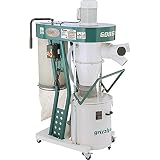
Grizzly G0861 2 HP Portable Cyclone Grizzly G0861 2 HP Portable Cyclone The step up from a bag collector. Cyclone separation keeps the filter clean, which is the thing that quietly halves a bag unit's airflow after a few months. Check price on Amazon → Powermatic TurboCone Dust Collector Powermatic TurboCone Dust Collector Two-micron canister and enough static pressure to run a long duct main rather than dragging a hose to each machine. Check price on Amazon → JET 14 in Bandsaw, 1.75 HP JET 14 in Bandsaw, 1.75 HP Thirteen inches of resaw. The machine that turns expensive boards into two boards, which is where it pays for itself. Check price on Amazon → Powermatic 8 in Helical Jointer Powermatic 8 in Helical Jointer Helical head, so figured stock comes off flat instead of torn out. The one machine most shops regret buying small. Check price on Amazon →

As an Amazon Associate we earn from qualifying purchases, at no extra cost to you. Prices change, so check before buying.