For most people a random orbital sander is better: its random orbit pattern removes stock faster and leaves fewer swirl marks on flat panels and tabletops. A 1/4 sheet sander is the better tool for inside corners and edges, and it runs on cheap sandpaper cut from standard sheets. Buy the orbital first (the SKIL 5 in. at under $50, or the Bosch ROS20VSC at under $100), then add a sheet sander like the SKIL 7292-02 (under $50) for corners.
Verdict
A random orbital sander spins and oscillates at once, so it never traces the same path and leaves no consistent scratch pattern. That makes it the default for flat surfaces and the fastest way to remove material without swirls. A sheet sander is square, so it reaches into corners and along edges an orbital cannot. Buy the orbital first; add the sheet sander for corners and detail.
 Best all-round (budget)
SKIL 5 in Random Orbital Sander
2.8 A, 13,000 OPM, variable speed, cyclonic dust box | under $50
Check SKIL 5 in Random Orbital Sander Price Best for corners (budget)
SKIL 1/4 Sheet Palm Sander
2.0 A, pressure-control warning, micro-filter dust canister | under $50
Check SKIL 1/4 Sheet Palm Sander Price Step-up random orbital
Bosch ROS20VSC Random Orbital Sander
2.5 A, 7,500-12,000 OPM variable speed, 1/2-micron dust canister | under $100
Check Bosch ROS20VSC Random Orbital Sander Price Step-up sheet sander
DEWALT DWE6411 1/4 Sheet Sander
2.3 A, 14,000 OPM, locking dust port, counterweight for low vibration | under $100
Check DEWALT DWE6411 1/4 Sheet Sander Price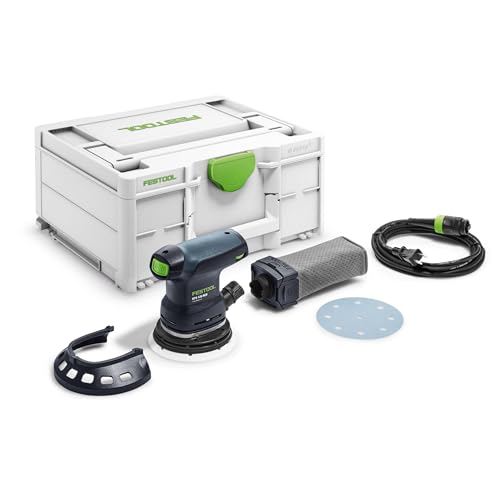 Premium random orbital
Festool ETS 125 REQ-Plus
Variable speed, vibration-stop balance, Jetstream dust extraction, Systainer case | under $500
Check Festool ETS 125 REQ-Plus PriceRandom Orbital vs Sheet Sander: At a Glance
| SKIL 5 in Random Orbital Sander | SKIL 1/4 Sheet Palm Sander | |
|---|---|---|
| Swirl marks | None if used correctly | Possible with pressure |
| Reaches corners | No, round pad | Yes, square pad |
| Stock removal | Faster | Slower |
| Paper cost | Hook and loop discs, pricier | Cut from sheets, cheap |
| Dust collection | Usually good | Fair; canister or vacuum port |
| Best for | Flat panels and tabletops | Edges, corners, detail |
| Finish quality | Finer; random orbit avoids a repeating scratch pattern | Good for final passes if you keep pressure light |
| Sandpaper | 5 in. hook and loop discs (about $0.30 to $1 each) | Any standard 9 x 11 in. sheet, cut in quarters |
| Budget pick | SKIL 5 in. ROS (under $50) | SKIL 7292-02 (under $50) |
| Step-up pick | Bosch ROS20VSC (under $100) | DEWALT DWE6411 (under $100) |
| Premium pick | Festool ETS 125 REQ-Plus (under $500) | Rarely worth paying up for |
Choose the SKIL 5 in Random Orbital Sander if…
You are flattening panels, tabletops or anything broad. Let the tool's weight do the work: pressing down defeats the random orbit and is the main cause of the swirl marks people blame on the sander.
Check SKIL 5 in Random Orbital Sander on Amazon
Choose the SKIL 1/4 Sheet Palm Sander if…
You are sanding into inside corners, along rebates, or working small pieces. A square pad is the only power sander shape that reaches a corner, and cutting your own paper from sheets makes it very cheap to run.
Check SKIL 1/4 Sheet Palm Sander on Amazon
Frequently Asked Questions
For most sanding, yes. A random orbital (random orbit) sander spins and oscillates at the same time, so it removes stock faster and does not leave a repeating scratch pattern on flat panels. A sheet sander is better only where its square pad matters: inside corners, against edges and in tight spots. Most shops end up with both, orbital first.
A random orbital sander, used correctly. Its random path hides scratches that a fixed-orbit sheet sander can leave as small loops. Swirls from either tool usually come from pressing too hard, moving too fast, skipping grits or a worn pad, so let the sander's weight do the work.
Yes. That is its main running-cost advantage. A 1/4 sheet sander takes a quarter of a standard 9 x 11 inch sheet, held by clamps, so you can cut paper from bulk sheets. Some models also accept pre-punched hook and loop pads; punch dust holes if you want the dust port to work.
Not always. Palm sander is a size description: both 1/4 sheet sanders and 5 inch random orbital sanders are held in the palm. A sheet (finishing) sander has a square pad and a fixed orbit; a random orbital sander has a round hook and loop pad and a random orbit.
Do not skip grits by more than one step. A common sequence is 80, 120, 180 and sometimes 220 for bare wood. Skipping straight to fine paper simply polishes the deeper scratches rather than removing them.
Usually pressing too hard, moving too fast, or skipping a grit. Finish makes existing scratches visible rather than creating them, so the fix is in the sanding sequence rather than the finish.
Yes, for your lungs more than for cleanliness. Fine wood dust is the fraction that reaches deep into the lungs, and some species are sensitising or carcinogenic. Connect the sander and wear a rated respirator.
Comparison based on published manufacturer specifications and the general consensus of owner reports. We have not tested these units side by side. Confirm current prices and specifications before buying. This is researched general information, not professional advice. As an Amazon Associate we earn from qualifying purchases, at no extra cost to you.