
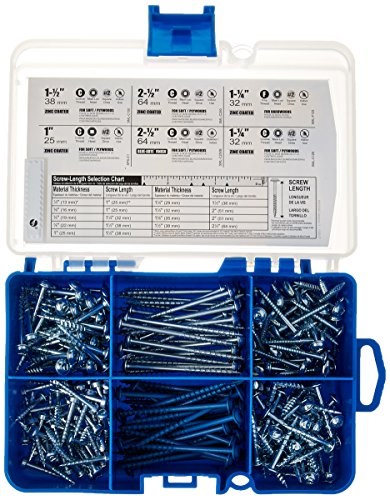

Pocket Hole Screw Length by Wood Thickness
Pocket hole systems key everything to the thickness of the board you drill the pocket into. Set the jig body and the drill bit's depth collar to that thickness, then use the screw length from the chart. These settings follow the standard used by Kreg-style jigs.
| Material Thickness | Common Stock | Jig Setting | Drill Collar Setting | Screw Length |
|---|---|---|---|---|
| 1/2 in. | 1/2 in. plywood, drawer boxes | 1/2 in. | 1/2 in. | 3/4 in. |
| 5/8 in. | 5/8 in. plywood, some shelving | 5/8 in. | 5/8 in. | 1 in. |
| 3/4 in. | 3/4 in. plywood, 1x boards (1x2 to 1x12) | 3/4 in. | 3/4 in. | 1-1/4 in. |
| 7/8 in. | Thick shelving, some door stiles | 7/8 in. | 7/8 in. | 1-1/2 in. |
| 1 in. | 5/4 deck boards (1 in. actual), butcher block | 1 in. | 1 in. | 1-1/2 in. |
| 1-1/8 in. | Stair treads, thick tabletops | 1-1/8 in. | 1-1/8 in. | 1-1/2 in. |
| 1-1/4 in. | Full 5/4 hardwood stock | 1-1/4 in. | 1-1/4 in. | 2 in. |
| 1-3/8 in. | Interior door stiles | 1-3/8 in. | 1-3/8 in. | 2-1/2 in. |
| 1-1/2 in. | 2x4, 2x6, 2x8 construction lumber | 1-1/2 in. | 1-1/2 in. | 2-1/2 in. |
Joining two different thicknesses
Drill the pocket in the thinner board and set the jig, collar, and screw length to that board's thickness. Example: attaching a 3/4 in. rail to a 1-1/2 in. leg, drill the 3/4 in. rail and use 1-1/4 in. screws. The screw only needs to grab the mating piece; it must never risk punching through its face.
Coarse vs Fine Thread: Match the Screw to the Wood
Thread choice matters as much as length. Coarse threads grip soft, low-density fibers; fine threads drive cleanly into dense hardwood without splitting it.
| Material | Thread Type | Why |
|---|---|---|
| Pine, fir, spruce, cedar (softwoods) | Coarse | Deep threads bite soft fibers and resist stripping |
| Plywood (all thicknesses) | Coarse | Grips layered veneers that fine threads tear out of |
| MDF and particleboard | Coarse | Maximum hold in low-density composite cores |
| Poplar, alder, soft maple | Coarse or fine | Medium-density woods accept either; coarse is common |
| Oak, hard maple, walnut, cherry, hickory | Fine | Lower driving torque, far less splitting in dense grain |
| Outdoor projects (any species) | Match wood, exterior coating | Use coated or stainless exterior pocket screws for weather exposure |
Head types and coatings
Standard pocket screws use a flat-bottomed washer head that seats on the pocket's shoulder. Use pan-head screws for 1/2 in. material, where the smaller head fits the shallower pocket. For coatings: plain zinc is fine indoors, and exterior-rated coatings or stainless steel are for anything that sees weather. Square or Torx-style drives resist cam-out far better than Phillips.
Spacing, Clamping, and Avoiding Split Joints
- Screw spacing: use two screws per joint on face frames and rails up to 3 in. wide, three screws on boards 4 to 6 in. wide, and a screw every 6 to 8 in. along panel edges.
- Clamp every joint: the screw's driving force tries to slide the boards apart. A face clamp across the joint keeps surfaces flush; without it, joints step and creep.
- Set your driver's clutch: drive until the washer head seats firmly, then stop. Overdriving through the pocket shoulder is the most common cause of blown-out joints in softwood and MDF.
- Keep 1 in. of edge distance: pockets drilled too close to the end of a board can split out. Position pockets at least an inch from board ends when possible.
- Hide the evidence: pocket holes accept glued wooden plugs sold by species, or place pockets on the unseen face and skip plugs entirely.
Pocket screws handle the clamping while glue provides long-term strength; see the wood glue dry and cure time chart for open and clamp times. For traditional screw joinery through the face of a board, use the pilot hole chart and wood screw chart instead. Building cabinets or a bench? The cabinet materials calculator and workbench materials calculator will size your lumber order.