Socket Size Chart

Photo via Unsplash
Complete reference matching SAE and metric bolt sizes to the correct socket. Plus drive sizes, 6-point vs 12-point, and shallow, deep, and impact socket selection.
Photo via Unsplash
Complete reference matching SAE and metric bolt sizes to the correct socket. Plus drive sizes, 6-point vs 12-point, and shallow, deep, and impact socket selection.
As an Amazon Associate, we earn from qualifying purchases. See all recommendations
Reaching for the wrong socket rounds off bolt heads and wastes time. This chart matches every common SAE and metric bolt to the correct socket size, then explains drive sizes, 6-point versus 12-point sockets, and when to use shallow, deep, or impact sockets. Bookmark it for the garage and the workbench.
The socket size equals the distance across the flats of the bolt head or nut, not the bolt's thread diameter. Common SAE: a 1/4" bolt takes a 7/16" socket, a 3/8" bolt a 9/16", and a 1/2" bolt a 3/4". Common metric: M6 = 10mm, M8 = 13mm, M10 = 16 or 17mm, M12 = 18 or 19mm. Drive sizes are 1/4" (small), 3/8" (general), and 1/2" (heavy). See the full SAE and metric chart below.
One mechanics tool set puts every SAE and metric socket in the chart below in your box, with ratchets in all three drive sizes.
 Better Pick
GEARWRENCH 243-Piece Mechanics Tool Set (80966)
6-point sockets, SAE + metric, 3-drawer steel box
Under $500
Check Price on Amazon
Better Pick
GEARWRENCH 243-Piece Mechanics Tool Set (80966)
6-point sockets, SAE + metric, 3-drawer steel box
Under $500
Check Price on Amazon
 Good Pick
DEWALT 192-Piece Mechanics Tool Set (DWMT75049)
1/4", 3/8" and 1/2" drives, SAE + metric, 6-point
Under $250
Check Price on Amazon
Good Pick
DEWALT 192-Piece Mechanics Tool Set (DWMT75049)
1/4", 3/8" and 1/2" drives, SAE + metric, 6-point
Under $250
Check Price on Amazon
 Budget Pick
CRAFTSMAN 230-Piece Mechanics Tool Set (CMMT45306)
3 drives, SAE + metric, 3-drawer box
Under $250
Check Price on Amazon
Budget Pick
CRAFTSMAN 230-Piece Mechanics Tool Set (CMMT45306)
3 drives, SAE + metric, 3-drawer box
Under $250
Check Price on Amazon
Compare all 7 picks in our best socket sets guide →
As an Amazon Associate, WorkshopCalc earns from qualifying purchases. Prices are approximate and can change.
For SAE (inch) bolts, the number that matters is the bolt's nominal thread diameter. The socket size is the distance across the flats of the hex head, which is always larger than the bolt diameter. These are the standard hex-head wrench and socket sizes for common bolt diameters.
| Bolt Diameter | Socket / Wrench Size |
|---|---|
| 1/4" | 7/16" |
| 5/16" | 1/2" |
| 3/8" | 9/16" |
| 7/16" | 5/8" |
| 1/2" | 3/4" |
| 9/16" | 13/16" |
| 5/8" | 15/16" |
| 3/4" | 1-1/8" |
| 7/8" | 1-5/16" |
| 1" | 1-1/2" |



WorkshopCalc is an Amazon Associate and a Grizzly Industrial affiliate. We earn from qualifying purchases.
The sizes above are the standard hex-head dimensions for ordinary bolts. Some heavy hex, structural, and aftermarket bolts use a larger head for the same thread diameter. When in doubt, measure across the flats of the head with calipers and match that to the socket.
Metric bolts are designated by an "M" plus the thread diameter in millimeters (for example, M10 has a 10mm thread). The socket size again refers to the distance across the flats of the head. Several sizes have two common head options, so keep both sockets handy.
| Bolt Size | Socket Size |
|---|---|
| M3 | 5.5mm |
| M4 | 7mm |
| M5 | 8mm |
| M6 | 10mm |
| M8 | 13mm |
| M10 | 16mm or 17mm |
| M12 | 18mm or 19mm |
| M14 | 21mm or 22mm |
| M16 | 24mm |
| M18 | 27mm |
| M20 | 30mm |
Sizes like M10, M12, and M14 list two sockets because both standard and reduced or oversized head styles are common in the field. Automotive metric fasteners frequently use the smaller head (M10 = 16mm), while industrial and DIN-standard bolts may use the larger one (M10 = 17mm). Check the bolt before applying torque.
A socket set is where a shop starts. These are what people buy next once the hand tools are covered.
A typical mechanic's set spans these SAE and metric sizes. Having the full run prevents the frustration of being one size short on a job.
| System | Common Socket Sizes |
|---|---|
| SAE (inch) | 3/16", 1/4", 5/16", 3/8", 7/16", 1/2", 9/16", 5/8", 11/16", 3/4", 13/16", 7/8", 15/16", 1" |
| Metric (mm) | 4, 5, 6, 7, 8, 9, 10, 11, 12, 13, 14, 15, 16, 17, 18, 19, 20, 21, 22, 23, 24 |
The drive size is the square hole on the back of the socket that accepts the ratchet, breaker bar, or impact wrench. Bigger drives handle more torque but are bulkier in tight spots. Match the drive to the size and torque of the fastener.
Step-up and step-down adapters let you run, say, 3/8" sockets on a 1/2" ratchet. They are handy in a pinch, but avoid using a small drive with a large breaker bar on a stuck bolt, the adapter or the small ratchet can fail under the load.
The point count is the number of contact points inside the socket. It changes how the socket grips the fastener and how easily it engages.
Use 6-point sockets when torque is high or a bolt is corroded, they grip the flats and resist rounding. Use 12-point sockets when you need speed or can only get the socket on at an awkward angle. For impact wrenches, always use 6-point impact sockets.
Beyond size and point count, sockets come in different lengths and toughness ratings. Pick the type that fits the fastener and the tool you are driving it with.
| Socket Type | Best For | Notes |
|---|---|---|
| Shallow (Standard) | Most everyday bolts and nuts | Short body fits in shallow recesses; the default socket for general work |
| Deep | Bolts with long protruding threads, recessed nuts, studs | Longer body reaches over exposed thread to seat on the nut |
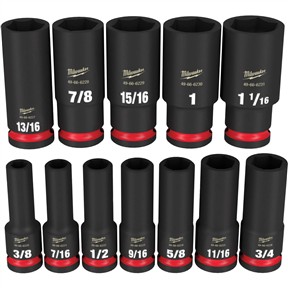
| Impact | Use with impact wrenches and high torque | Thicker walls, harder steel, black-oxide finish; do not use chrome sockets on impact tools |
Standard chrome (hand) sockets are hardened for strength and can shatter under the hammering action of an impact wrench, sending fragments flying. Always use impact-rated sockets, identifiable by their thicker walls and black finish, on impact tools.
A handful of SAE and metric sockets are dimensionally close enough that one will loosely fit a fastener meant for the other. This can save you in a pinch, but it is a compromise, not a substitute.
| SAE Socket | Metric Near-Equivalent | Actual Difference |
|---|---|---|
| 3/8" | 10mm | 3/8" = 9.5mm (0.5mm under) |
| 7/16" | 11mm | 7/16" = 11.1mm (0.1mm over) |
| 1/2" | 13mm | 1/2" = 12.7mm (0.3mm under) |
| 9/16" | 14mm | 9/16" = 14.3mm (0.3mm over) |
| 5/8" | 16mm | 5/8" = 15.9mm (0.1mm under) |
| 3/4" | 19mm | 3/4" = 19.05mm (0.05mm over) |
Even a fraction of a millimeter of slop lets the socket contact the corners of the head instead of the flats, which rounds off the bolt under load. Never use a near-equivalent on suspension, brakes, engine, or any high-torque fastener. Reach for the correct SAE or metric socket every time.
A good socket set covers SAE and metric in the drive sizes you use most. These are the categories worth owning. All links are affiliate links, we may earn a commission at no cost to you.
As an Amazon Associate, WorkshopCalc earns from qualifying purchases. This helps support the site at no additional cost to you. We only recommend products we would use in our own workshops.
Recommended torque values for SAE and metric bolts by grade and size.
View Chart →SAE and metric wrench sizes matched to bolt and nut sizes.
View Chart →Complete reference for fractional, number, letter, and metric drill bit sizes.
View Chart →Browse every WorkshopCalc reference chart in one place.
Browse All →Updated 2026. Metric sockets are labeled in millimeters and SAE sockets in fractions of an inch, so a 13 mm socket is 0.512 in, just over 1/2 in (0.500 in). The table converts the metric sizes found in a standard socket set. The last column is the nearest 64th, for comparison only: a fractional socket that is smaller than the head will not fit, and one that is larger will round it, so use the socket that matches the head.
| Metric Socket | Inches (decimal) | Nearest Fraction |
|---|---|---|
| 6 mm | 0.236" | 15/64" |
| 7 mm | 0.276" | 9/32" |
| 8 mm | 0.315" | 5/16" |
| 9 mm | 0.354" | 23/64" |
| 10 mm | 0.394" | 25/64" |
| 11 mm | 0.433" | 7/16" |
| 12 mm | 0.472" | 15/32" |
| 13 mm | 0.512" | 33/64" |
| 14 mm | 0.551" | 35/64" |
| 15 mm | 0.591" | 19/32" |
| 16 mm | 0.630" | 5/8" |
| 17 mm | 0.669" | 43/64" |
| 18 mm | 0.709" | 45/64" |
| 19 mm | 0.748" | 3/4" |
| 20 mm | 0.787" | 25/32" |
| 21 mm | 0.827" | 53/64" |
| 22 mm | 0.866" | 55/64" |
| 24 mm | 0.945" | 15/16" |
| 27 mm | 1.063" | 1-1/16" |
| 30 mm | 1.181" | 1-3/16" |
| 32 mm | 1.260" | 1-17/64" |
Metric socket sets run in 1 mm steps from 8 mm to 19 mm, then 21, 22, 24, 27, 30 and 32 mm. There is no standard socket between 13 mm and 14 mm: the next size up from 13 mm is 14 mm.
| Job | Typical Socket | Drive |
|---|---|---|
| Lug nuts (most cars) | 19 mm, 21 mm or 3/4", 13/16" | 1/2" drive |
| Lug nuts (some trucks and imports) | 17 mm or 22 mm | 1/2" drive |
| Spark plugs | 5/8" (16 mm) or 13/16" (21 mm) spark plug socket | 3/8" drive |
| Battery terminal bolts | 10 mm or 13 mm | 3/8" drive |
| M6 bolt head | 10 mm | 1/4" drive |
| M8 bolt head | 13 mm | 1/4" or 3/8" drive |
| M10 bolt head | 16 mm or 17 mm | 3/8" drive |
| M12 bolt head | 18 mm or 19 mm | 3/8" or 1/2" drive |
Lug nut sizes vary by make and wheel, so test-fit the socket on the nut before applying torque. Look up the torque for the bolt in our bolt torque chart and the wrench size in the wrench size chart.
A 1/2 inch bolt, meaning a bolt with a 1/2 inch thread diameter, has a standard hex head that takes a 3/4 inch socket. Socket size is measured across the flats of the bolt head, not by the thread diameter, so the socket is always larger than the bolt's nominal size. If the head looks unusual (some grade 8 or aftermarket bolts vary), measure across the flats with calipers to confirm before reaching for the 3/4 inch socket.
No, metric and SAE sockets are not truly interchangeable, though a few sizes are close enough to fit loosely. For example, a 3/8 inch socket is about 9.5mm (close to 10mm) and a 1/2 inch socket is about 12.7mm (close to 13mm). Using a near-equivalent on a critical fastener risks rounding off the corners of the head, because the slight gap lets the socket slip under torque. Always use the matching socket on suspension, brake, engine, or any high-torque fastener.
A 6-point socket has six contact points and grips the flats of a hex fastener, giving it more surface contact and better resistance to rounding under high torque. A 12-point socket has twelve points and fits onto the fastener in twice as many positions, making it faster to engage in tight spaces, but it contacts closer to the corners of the head and is more likely to slip or round a stubborn bolt. Use 6-point for high torque and rusted fasteners, and 12-point for speed and access.
Drive size is the square hole that connects the socket to the ratchet. Use 1/4 inch drive for small fasteners and detail work (roughly up to 1/4 inch / 13mm sockets), 3/8 inch drive for the majority of general automotive and household work, and 1/2 inch drive for large or high-torque fasteners like lug nuts and suspension bolts. A 3/8 inch drive set covers most jobs; add 1/4 inch and 1/2 inch drives as your work demands.
An M10 bolt (10mm thread diameter) most commonly takes a 16mm or 17mm socket, depending on whether it has a standard or a larger head. Both head sizes are common, so check the bolt or have both sockets handy. As with all fasteners, socket size is the distance across the flats of the head, not the M10 thread diameter.
A 13 mm socket is 0.512 inches, just over 1/2 inch (0.500 in). A 1/2 inch socket is about 0.3 mm too small to fit a 13 mm head, so it will not slide on, and the next fractional size up (33/64 in) is not a standard socket. Use a 13 mm socket for M8 bolts and nuts.
No. Standard metric socket sets go up in 1 mm steps from 8 mm to 19 mm, so 13 mm is followed by 14 mm. If a head is between the two, measure it across the flats with calipers; it is probably a worn or damaged head.
Most passenger car lug nuts take a 19 mm (3/4 in) or 21 mm (13/16 in) socket, with 17 mm and 22 mm common on some imports and trucks. Use a 6-point, 1/2 inch drive socket, ideally a thin-wall or impact-rated one that matches the nut, and check the fit before applying torque.
An M8 bolt has a 13 mm hex head in the standard metric series, so it takes a 13 mm socket. Some Japanese-made hardware uses a 12 mm head on M8 bolts.
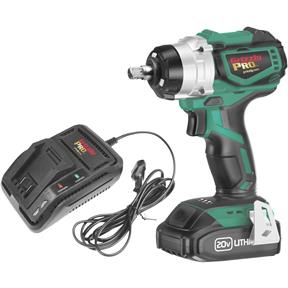
Gear for this: see our best cordless impact wrenches guide.