
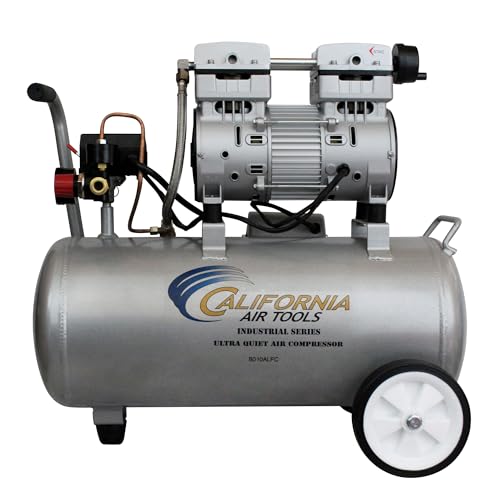

Air Tool CFM Requirements Chart
Average air consumption at 90 PSI for common air tools, based on published manufacturer specifications. Intermittent tools (nailers, impacts, ratchets) are rated on typical duty cycles of about 25 percent; continuous tools (sanders, grinders, spray guns) draw their full rating the entire time the trigger is down. Always check the spec plate on your specific tool, since models vary.
| Air Tool | Avg CFM @ 90 PSI | Operating PSI | Duty | Min Compressor CFM (1.5x) |
|---|---|---|---|---|
| Pin nailer (23 ga) | 0.2 | 60–100 | Intermittent | 0.3 |
| Brad nailer (18 ga) | 0.3 | 70–100 | Intermittent | 0.5 |
| Finish nailer (15/16 ga) | 0.5 | 70–110 | Intermittent | 0.8 |
| Crown stapler | 0.5 | 70–100 | Intermittent | 0.8 |
| Tire inflator / chuck | 1–2 | 32–90 | Intermittent | 2–3 |
| Framing nailer | 2.2 | 90–120 | Intermittent | 3.3 |
| Roofing nailer | 2.5 | 90–120 | Intermittent | 3.8 |
| Blow gun / duster | 2.5 | 90 | Intermittent | 3.8 |
| Grease gun | 3 | 90–120 | Intermittent | 4.5 |
| Air ratchet (3/8 in.) | 3 | 90 | Intermittent | 4.5 |
| Impact wrench (3/8 in.) | 3.5 | 90 | Intermittent | 5.3 |
| Air ratchet (1/2 in.) | 4 | 90 | Intermittent | 6 |
| Air hammer / chisel | 4 | 90–100 | Intermittent | 6 |
| Impact wrench (1/2 in.) | 4.5 | 90 | Intermittent | 7 |
| Air drill (3/8 in.) | 4 | 90 | Continuous | 6 |
| Cut-off tool (3 in.) | 5 | 90 | Continuous | 7.5 |
| Air drill (1/2 in.) | 5.5 | 90 | Continuous | 8.3 |
| Air saw / body saw | 6 | 90 | Continuous | 9 |
| Die grinder (1/4 in.) | 6 | 90 | Continuous | 9 |
| Angle grinder (4-1/2 in.) | 6.5 | 90 | Continuous | 10 |
| Impact wrench (3/4 in.) | 7 | 90–100 | Intermittent | 10.5 |
| Needle scaler | 8 | 90 | Continuous | 12 |
| Straight-line / air file sander | 8 | 90 | Continuous | 12 |
| Angle grinder (7 in.) | 8.5 | 90 | Continuous | 13 |
| HVLP spray gun | 9–12 | 25–45 (at inlet 90) | Continuous | 14–18 |
| Impact wrench (1 in.) | 10 | 90–120 | Intermittent | 15 |
| DA / random orbital air sander | 11 | 90 | Continuous | 16.5 |
| Conventional spray gun | 12 | 40–60 | Continuous | 18 |
| Sandblast cabinet | 8–15 | 80–100 | Continuous | 12–23 |
| Pressure-pot sandblaster | 15–25 | 90–100 | Continuous | 23+ |
Reading the chart
Green rows run happily on a pancake or quiet 8 gallon compressor. Amber rows want a 20 to 30 gallon unit delivering 5 to 7 CFM. Red rows are continuous or high-draw tools that need a 60 gallon class two-stage compressor, or they will outrun the pump.
The machines these numbers are really about
Sizing a duct run or a cut list is planning for a machine you either own or are about to buy. These four are the ones that change what the shop can do, rather than making the current setup slightly tidier.
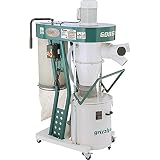 Grizzly G0861 2 HP Portable Cyclone
The step up from a bag collector. Cyclone separation keeps the filter clean, which is the thing that quietly halves a bag unit's airflow after a few months.
Check price on Amazon →
Grizzly G0861 2 HP Portable Cyclone
The step up from a bag collector. Cyclone separation keeps the filter clean, which is the thing that quietly halves a bag unit's airflow after a few months.
Check price on Amazon →
 Powermatic TurboCone Dust Collector
Two-micron canister and enough static pressure to run a long duct main rather than dragging a hose to each machine.
Check price on Amazon →
Powermatic TurboCone Dust Collector
Two-micron canister and enough static pressure to run a long duct main rather than dragging a hose to each machine.
Check price on Amazon →
 JET 14 in Bandsaw, 1.75 HP
Thirteen inches of resaw. The machine that turns expensive boards into two boards, which is where it pays for itself.
Check price on Amazon →
JET 14 in Bandsaw, 1.75 HP
Thirteen inches of resaw. The machine that turns expensive boards into two boards, which is where it pays for itself.
Check price on Amazon →
 Powermatic 8 in Helical Jointer
Helical head, so figured stock comes off flat instead of torn out. The one machine most shops regret buying small.
Check price on Amazon →
Powermatic 8 in Helical Jointer
Helical head, so figured stock comes off flat instead of torn out. The one machine most shops regret buying small.
Check price on Amazon →
As an Amazon Associate we earn from qualifying purchases, at no extra cost to you. Prices change, so check before buying.
Compressor Size Classes: What Each One Can Run
Typical delivered CFM at 90 PSI by compressor class. Individual models vary, so match the spec sheet, not the tank size.
| Compressor Class | Typical CFM @ 90 PSI | Runs Comfortably | Struggles With |
|---|---|---|---|
| 1–3 gal trim / hotdog | 0.6–2.0 | Pin, brad, and finish nailers; inflation | Framing nailers in rapid fire; any wrench work |
| 6 gal pancake | 2.0–2.6 | All nailers, staplers, blow gun, inflation | Impact wrenches beyond quick jobs; any continuous tool |
| 8–10 gal ultra-quiet | 2.0–3.0 | Nailers, inflation, light ratchet work indoors | Grinders, sanders, spray guns |
| 20–30 gal single-stage | 4.0–7.0 | 1/2 in. impacts, ratchets, air hammers, short die-grinder bursts | DA sanding, spraying, blasting for more than a minute |
| 60 gal two-stage | 11–14 | DA sanders, HVLP spraying, grinders, most auto body work | Large pressure-pot blasting all day |
| 80 gal two-stage | 14–17+ | Continuous production work, blasting, multiple users | Very little in a home shop |
How to Size an Air Compressor (the 1.5x Rule)
- Find your hungriest tool. List the tools you will actually run and note the highest CFM at 90 PSI figure. Ignore tools you will never use at the same time.
- Multiply by 1.5. Manufacturer ratings assume ideal conditions and, for intermittent tools, a light duty cycle. The 1.5x margin keeps the pump from running 100 percent of the time and covers leaks and fitting losses.
- Check the duty cycle. If the tool is continuous-use (sander, grinder, spray gun), your compressor must deliver the full number indefinitely. If it is intermittent (nailer, impact), a bigger tank can substitute for some pump capacity.
- Then look at tank size. Tanks are reserve, not supply. For burst tools, more gallons mean fewer motor starts. For continuous tools, the tank only delays the moment the pump falls behind.
- Remove the bottlenecks. A 1/4 in. hose can choke a high-CFM tool. Run 3/8 in. hose for anything beyond nailers, and use matched quick-connect fittings such as the Milton S-210 1/4 in. NPT M-Style coupler and plug kit so every tool and hose end speaks the same style.
SCFM vs CFM
SCFM is CFM normalized to standard conditions (68°F, 14.7 PSI atmospheric, 36 percent humidity). Most tool and compressor specs in the US quote SCFM at 90 PSI, so comparing SCFM to SCFM at the same pressure is an apples-to-apples comparison. Just never compare a 40 PSI rating against a 90 PSI rating.
Planning the rest of the system? The air compressor setup guide covers piping, drying, and regulator layout, and the best air compressors guide compares current models by class. Note that this chart is for compressed-air tools; dust collection airflow is a different measurement covered in the dust collector CFM chart.