Best Air Compressor for Home Garage and Shop (2026)
The best air compressor for most garages is the Campbell Hausfeld 60-gallon 2-stage (under $1,000): 7.6 SCFM at 90 PSI and 175 PSI on a 230V circuit. No 240V outlet? The DEWALT DXCM271 27-gallon runs on 120V at 5.1 SCFM, and a 20-gallon like the Craftsman (4 SCFM, under $1,000) covers nailers, tires and impact-wrench bursts. Buy for the CFM at 90 PSI of your hungriest tool plus 30 to 50 percent.
Choosing an air compressor for a garage or workshop comes down to one number: CFM at 90 PSI. Nailers and tire inflation need very little air; impact wrenches and ratchets need more; sanders, grinders and spray guns need a lot, continuously. This guide ranks 9 compressors across that range, from a 2.5-gallon trim compressor to an 80-gallon two-stage shop unit, with a 120V pick for garages without a 240V circuit. Picks are based on manufacturer specifications and verified owner reviews; prices are approximate and were checked in 2026.
The best air compressor for most garages is the Campbell Hausfeld 60-Gallon 2-Stage (under $1,000): a two-stage cast-iron pump, 7.6 SCFM at 90 PSI and 175 PSI on a 230V circuit. No 240V outlet? The DEWALT DXCM271 27-gallon runs on 120V at 5.1 SCFM. Rule of thumb: buy for the CFM at 90 PSI of your hungriest tool plus 30 to 50 percent; nailers need 2 to 4 CFM, impact wrenches and ratchets 4 to 6, and sanders, grinders and spray guns 8 to 14+.
Quick Picks: Best Air Compressors for 2026
Short on time? These are the picks by use, each chosen on rated CFM at 90 PSI, tank size, pump type and price.

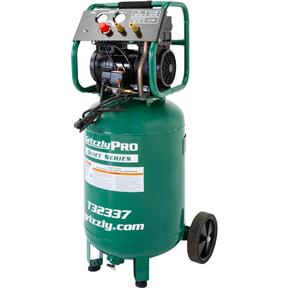
Prefer to buy direct? The Grizzly PRO T32337 20-Gallon Oil-Free Quiet Series Air Compressor is a quiet oil-free shop compressor with enough tank for nailers, blow guns and short spray sessions from Grizzly Industrial, often priced lower factory-direct than through a reseller and backed by full parts availability and U.S. support.
Shop the T32337 at Grizzly.com →Not Sure What Size You Need?
Use our Air Compressor CFM Calculator to determine exact requirements based on your tools.
Air Compressor Comparison Table
Specs as published on each manufacturer listing. CFM is at 90 PSI; "see listing" means the listing does not state it.
| Model | Tank | CFM @ 90 PSI | Pump | Voltage | Budget |
|---|---|---|---|---|---|
| CH 60-Gallon 2-Stage | 60 gal vertical | 7.6 SCFM | Two-stage, oil-lubricated | 230V | Under $1,000 |
| DEWALT DXCM602 60-Gallon | 60 gal vertical | 11.5 CFM | Oil-lubricated (see listing) | 208/230V | Under $2,500 |
| CH 80-Gallon HS5180 | 80 gal vertical | 14.0 CFM | Two-stage, oil-lubricated | 230V, 22A | Under $2,500 |
| Quincy QT-54 | 60 gal vertical | See listing | Two-stage, splash lubricated | 230V, 1-phase | Under $2,500 |
| DEWALT DXCM271 27-Gallon | 27 gal vertical | 5.1 SCFM | Oil-free | 120V | Under $1,000 |
| Craftsman 20-Gallon | 20 gal | 4 SCFM | Oil-free | 120V | Under $1,000 |
| California Air Tools 10020C | 10 gal steel | 5.3 CFM | Oil-free dual piston | 120V | Under $500 |
| Makita MAC2400 | Twin-stack (see listing) | 4.2 CFM | Oil-lubricated, cast iron | 120V | Under $500 |
| Rolair JC10 Plus | 2.5 gal | 2.35 CFM | Oil-less | 120V | Under $500 |
In-Depth Air Compressor Reviews
Each review below is based on the manufacturer's published specifications and recurring themes in verified owner reviews. We did not bench-test these compressors. Prices are approximate and change often.

The Campbell Hausfeld 60-Gallon 2-Stage is the compressor we would put in most serious home garages. Campbell Hausfeld lists an oil-lubricated, two-stage cast-iron pump rated for up to 10,000 hours of pump life (based on its B-10 bearing rating), 7.6 SCFM at 90 PSI and 6.9 SCFM at 175 PSI, and a 3.7 running HP induction motor on a dedicated 230/240V circuit.
That combination is the point: enough air for impact wrenches, die grinders, DA sanders and a small HVLP gun, a two-stage pump that reaches 175 PSI for extra tank reserve, and a 60-gallon vertical ASME tank on a 23 x 23 inch footprint that stays against the wall. It is the least expensive way into a genuine two-stage shop compressor on this list.
Pros
- Two-stage cast-iron pump, 175 PSI
- 7.6 SCFM at 90 PSI
- 60-gallon ASME tank on a 23 x 23 in footprint
- Oil-lubricated for cooler running and longer life
Cons
- Needs a dedicated 230/240V circuit
- Stationary, not portable
- Stock has been limited

If you plan to spray paint, sand for long stretches or run a die grinder continuously, air volume matters more than anything else. DEWALT lists the DXCM602 at 11.5 CFM at 90 PSI and 175 PSI max from a 3.7 HP oil-lubricated unit, on a 60-gallon ASME tank, with a spread-voltage motor that runs on 208V or 230V.
That is roughly half again the rated airflow of our top pick for about $280 more, which is the most CFM per dollar in the 60-gallon class on this list.
Pros
- 11.5 CFM at 90 PSI
- 175 PSI max
- 208V or 230V motor
- ASME tank, oil-lubricated
Cons
- Needs a 240V circuit
- More than most hobby garages need

Campbell Hausfeld 80-Gallon 2-Stage Air Compressor (HS5180)
Best for Spray PaintingThe Campbell Hausfeld HS5180 is the compressor for automotive refinishing, sanding and cutting. Campbell Hausfeld lists 14.0 CFM at 90 PSI and 13.7 CFM at 175 PSI from a commercial-duty, two-stage cast-iron pump rated for up to 10,000 hours (B-10), a 5 HP single-phase motor on 230V at 22 amps, and an 80-gallon vertical ASME tank with an oil sight glass and enclosed belt guard.
The 80-gallon tank plus 14 CFM keeps an HVLP gun or dual-action sander running without the pressure sag you get from smaller units.
Pros
- 14.0 CFM at 90 PSI
- 80-gallon tank for long paint passes
- Two-stage cast-iron pump
- Oil sight glass and belt guard
Cons
- Needs a 230V circuit sized for 22A
- Large and heavy
- Overkill for nailers and tire inflation

Quincy is the long-running name in industrial reciprocating compressors, and the QT-54 (model 2V41C60VC) is its step down into a home or small commercial shop: a 5 HP, 230V single-phase, splash-lubricated two-stage reciprocating compressor on a 60-gallon vertical tank.
The listing does not publish a CFM figure, so check the current listing and Quincy documentation for delivery at 90 PSI before you buy. You pay a premium for the Quincy pump and its reputation for long life.
Pros
- Industrial-grade Quincy two-stage pump
- 5 HP single-phase motor
- 60-gallon vertical footprint
Cons
- Most expensive pick
- CFM not listed on the product page
- Needs a dedicated 230V circuit

No 240V outlet in the garage? The DEWALT DXCM271 runs on a standard 120V circuit with a low-voltage easy-start motor. DEWALT lists 1.7 HP, 5.1 SCFM at 90 PSI and 6.8 SCFM at 40 PSI, an oil-free pump and a 78 dBA noise rating on a 27-gallon vertical tank.
5.1 SCFM covers nailers, tire inflation, ratchets and intermittent impact wrench use. It is not enough for continuous sanding or spray painting.
Pros
- Runs on 120V
- 5.1 SCFM at 90 PSI
- 78 dBA, quieter than most oil-free units
- Vertical tank saves floor space
Cons
- Not for continuous-use tools
- Oil-free pump wears faster than cast iron

The Craftsman CMXECXA0232043 is a 20-gallon, oil-free compressor with a 175 PSI max tank pressure, which stores more air than the usual 150 PSI budget unit. Craftsman lists 1.8 HP, 4 SCFM at 90 PSI, two quick couplers, a ball drain valve, wheels and a 6 foot cord.
It suits nailers, inflation, blow-off and light impact work. At 4 SCFM it will cycle often on a DA sander or grinder.
Pros
- 175 PSI tank pressure
- Two quick couplers
- Oil-free, low maintenance
- Standard outlet
Cons
- 4 SCFM limits continuous tools
- 1-year limited warranty

The California Air Tools 10020C is rated at 70 decibels, far below the 80 to 90 dB of most compressors, which matters in an attached garage or basement shop. The 2.0 HP motor runs at 1680 RPM and California Air Tools lists 5.30 CFM at 90 PSI and 6.40 CFM at 40 PSI, from an oil-free dual-piston pump rated for more than 3,000 hours.
An easy-start valve reduces start-up amps, useful in cold garages and on shared circuits, and the 10-gallon tank rolls on wheels.
Pros
- 70 dBA rated noise
- 5.3 CFM at 90 PSI
- Oil-free, low maintenance
- Easy-start valve
Cons
- 10-gallon tank cycles on continuous tools
- Pricier than louder units of the same size
For a compressor that moves between the garage and a job, the Makita MAC2400 is a long-running favorite. Makita lists a cast iron Big Bore pump that is oil-lubricated for cooler running, a 2.5 HP 4-pole motor producing 4.2 CFM at 90 PSI, a pump speed of 1,730 RPM for a 79 dB noise level, a low-amp-draw start that reduces tripped breakers, and a roll cage.
An oil-lubricated cast iron pump generally outlasts the oil-free pumps common in portable compressors, which is the reason to pay more than a pancake unit.
Pros
- Oil-lubricated cast iron pump
- Low amp draw at start-up
- 79 dB
- Roll cage protects the pump
Cons
- 4.2 CFM is not for continuous tools
- Needs oil changes
- Stock has been limited
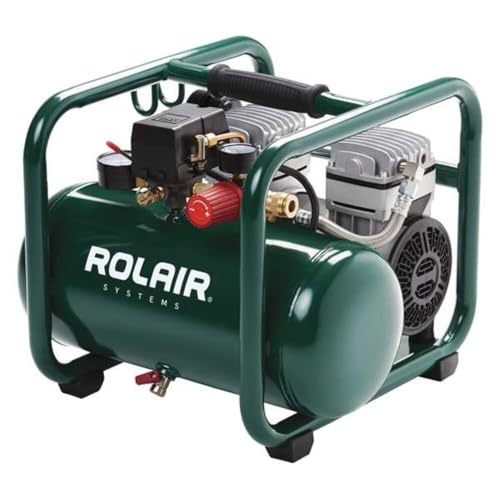
Finish carpenters buy the Rolair JC10 Plus to carry up stairs and run brad and finish nailers all day. Rolair lists 2.35 CFM at 90 PSI, a 1725 RPM motor, an oil-less design and a cast aluminum cylinder on a 2.5-gallon tank.
The slow-turning motor is why owners describe it as quiet for its class. It is a trim and nailer compressor, not a garage shop compressor.
Pros
- Light and portable
- Slow 1725 RPM motor
- Oil-less, minimal maintenance
Cons
- 2.35 CFM, nailers only
- 2.5-gallon tank
Compressor Sizing Guide by Use Case
Choosing the right size compressor depends entirely on your tools and usage patterns. This air compressor buying guide table shows recommended specifications for common workshop scenarios, and our air tool CFM chart lists the exact demand of each common tool.
| Use Case | Min CFM @ 90 PSI | Recommended Tank | Best Type |
|---|---|---|---|
| Brad/Finish Nailers Only | 2-3 CFM | 6-10 Gallon | Portable Oil-Free |
| Framing + Roofing Nailers | 4-5 CFM | 10-20 Gallon | Portable Oil-Lubricated |
| Light Automotive (Impact, Ratchet) | 5-7 CFM | 20-30 Gallon | Stationary Single-Stage |
| HVLP Spray Painting | 10-14 CFM | 60+ Gallon | Stationary Two-Stage |
| Die Grinders + Sanders | 8-12 CFM | 60+ Gallon | Stationary Single/Two-Stage |
| Sandblasting | 15-25 CFM | 60-80 Gallon | Stationary Two-Stage |
| Multiple Users Simultaneously | 15-25+ CFM | 80+ Gallon | Industrial Two-Stage |
Pro Tip: Add a Safety Margin
Always add 25-50% to your calculated CFM requirements. This accounts for air leaks, future tool additions, and ensures your compressor is not running at 100% capacity continuously. A compressor that never rests will fail much sooner than one with adequate headroom.
Calculate Your Exact Requirements
Select your specific tools and get personalized CFM and tank size recommendations.
Air Compressor Buyer's Guide: What to Look For
Understanding these key specifications will help you make an informed decision when shopping for the best air compressor for your garage or workshop.
CFM (Cubic Feet per Minute)
CFM measures air volume delivered by the compressor. This is the most critical specification for matching compressors to tools. Always compare CFM ratings at the same pressure, typically 90 PSI. A compressor rated at 10 CFM @ 40 PSI will deliver far less at working pressure.
Watch for misleading ratings: Displacement CFM and Free Air CFM are theoretical maximums. Look for CFM @ 90 PSI for accurate tool matching.
Tank Size
Tank size determines how long you can use air between compressor cycles and affects pressure stability.
Small Tanks (1-10 Gallon)
Best for portable use and intermittent tools like nailers.
- Highly portable
- Frequent motor cycling
- Good for nailers only
- Pressure fluctuations common
Medium Tanks (20-30 Gallon)
Versatile for most garage and workshop applications.
- Semi-portable or stationary
- Moderate motor cycling
- Handles most tools
- Good price/capacity balance
Large Tanks (60-80+ Gallon)
Required for continuous-use tools and spray painting.
- Stationary installation
- Less motor cycling
- Stable pressure delivery
- Best for spray painting
Oil-Lubricated vs Oil-Free
This choice significantly impacts maintenance, noise, lifespan, and air quality.
Oil-Lubricated
Better for serious shop use and longevity.
- Quieter operation
- Runs cooler
- Longer service life (2-3x)
- Requires oil changes
- May introduce oil into air
Oil-Free
Better for low maintenance and clean air needs.
- Zero oil maintenance
- No oil contamination risk
- Lighter weight typically
- Louder operation
- Shorter pump lifespan
Single-Stage vs Two-Stage
The compression method affects efficiency, air quality, and maximum pressure.
Single-Stage
Simpler design, adequate for most home shop needs.
- Lower initial cost
- Simpler maintenance
- 100-135 PSI typical max
- Runs hotter
- Good for intermittent use
Two-Stage
More efficient for continuous operation and high-demand tools.
- Higher efficiency
- Runs cooler
- Up to 175 PSI max
- Longer service life
- Better for continuous use
Noise Levels
Compressor noise is measured in decibels (dB). Every 10 dB increase represents a perceived doubling of loudness.
- 60-70 dB: Ultra-quiet, near conversation level (the California Air Tools 10020C is rated at 70 dBA)
- 70-80 dB: Moderate, similar to a vacuum cleaner
- 80-90 dB: Loud, hearing protection recommended
- 90+ dB: Very loud, common for industrial units
For workshops in or near living spaces, prioritize compressors under 75 dB. Oil-lubricated and belt-driven compressors are generally quieter than oil-free direct-drive models.
Electrical Requirements
Ensure your electrical service can support your compressor choice.
- 120V (Standard Outlet): Adequate for compressors up to about 2 HP. Convenient but limits motor size.
- 240V (Like Dryer Outlet): Required for most 3+ HP compressors. More efficient motor operation and lower amp draw.
- Dual Voltage: Some compressors can be wired for either 120V or 240V, providing flexibility.
Electrical Installation Note
Installing a 240V outlet requires an electrician and permit in most areas. Factor this cost into your budget when considering larger compressors. The typical cost runs $150-$400 depending on your electrical panel location and local rates.
Sources
- Manufacturer specification sheets for each compressor (CFM at 90 PSI, tank size, pump type, voltage)
- Air tool consumption figures from tool manufacturers' published CFM ratings
- Amazon.com listings, prices and stock checked 2026 through the Amazon Associates product API
Researched from published specifications and standards, not hands-on testing. Not professional advice.
Upgrade Pick and What You'll Also Need
A compressor is only useful with the plumbing between it and the tool. These are the parts almost every setup needs, plus the step up for a full shop.
- Upgrade pick: the Quincy QT-54, a 5 HP splash-lubricated two-stage unit built for continuous-duty shop air.
- A hose that does not kink: Flexzilla 3/8 in. x 50 ft air hose stays flexible in a cold garage.
- Quick couplers: a Milton 1/4 in. NPT M-style coupler and plug kit, 12 pieces fits most air tools.
- Filter and regulator: a NANPU filter and regulator combo keeps water out of spray guns and sets tool pressure at the hose.
Outfitting the whole shop? Our workshop setups list complete tool sets for a beginner, intermediate and pro shop.
Deal season note: Prices on these often drop during Prime Big Deal Days and Black Friday. The picks and prices above were checked against live Amazon listings for 2026; if a price looks different when you click through, the listing has changed since.
Frequently Asked Questions
Yes, if you run air-hungry tools. A 60-gallon two-stage unit like the Campbell Hausfeld (7.6 SCFM at 90 PSI) keeps up with sanders, die grinders and spray guns that a 20-gallon cannot sustain. It needs a 230V circuit and floor space, so for nailers, tire inflation and occasional impact-wrench work a 20 to 30 gallon 120V compressor is enough.
Brad, finish and framing nailers, tire inflation, blow guns and short bursts from a 1/2 inch impact wrench. At about 4 SCFM at 90 PSI (Craftsman 20-gallon), it cannot keep up with continuous-use tools like dual-action sanders or HVLP spray guns, which need 8 to 14 CFM.
For most garages the best air compressor is a 60-gallon two-stage unit like the Campbell Hausfeld 60-Gallon 2-Stage (7.6 SCFM at 90 PSI, 175 PSI, 230V). If you do not have a 240V circuit, the DEWALT DXCM271 27-gallon runs on 120V and delivers 5.1 SCFM at 90 PSI. Size by CFM at 90 PSI for your hungriest tool, plus 30 to 50 percent headroom.
For home use most people need 4 to 6 SCFM at 90 PSI on a standard outlet, which covers nailers, tires, blow guns and intermittent impact wrench use. The DEWALT DXCM271 (5.1 SCFM, 120V) and the quieter California Air Tools 10020C (5.3 CFM, 70 dBA) are the picks. Step up to 240V and 60 gallons only if you run sanders, grinders or spray guns.
The Campbell Hausfeld 60-Gallon 2-Stage gives the most shop capability per dollar here: a two-stage cast-iron pump, 175 PSI and 7.6 SCFM for under $1,000. On a tighter budget, the Craftsman 20-gallon (4 SCFM, 175 PSI) costs under $1,000.
Match the compressor to your tools' CFM, not horsepower. A brad nailer or tire inflation needs about 1 to 2 CFM and a small portable is plenty. Impact wrenches, ratchets and DA sanders want 4 to 6 CFM and a 20 to 30 gallon unit. Continuous tools like spray guns, grinders and sandblasters need 8 to 14+ CFM and a 60 to 80 gallon two-stage. Add 30 to 50 percent headroom. Use our air compressor calculator for your tool list, and see our best sandblasting cabinets guide if blasting is on the list.
For nailers, tires, blow-off and occasional impact wrench use, yes. A 20 to 30 gallon compressor at 4 to 6 SCFM handles those because the tank buffers short bursts. It is not big enough for continuous tools like DA sanders, die grinders or spray guns, which need 8 CFM or more and a 60 gallon tank to avoid constant cycling.
Look up each tool's CFM at 90 PSI, then size the compressor to your highest-demand tool. Continuous-use tools such as grinders, sanders and spray guns need the compressor's rated CFM to exceed the tool's requirement. Intermittent tools like impact wrenches and nailers can run on less because the tank buffers short bursts. See our air tool CFM chart for common ratings.
HVLP spray guns typically need about 8 to 12 CFM continuous, and conventional guns 12 to 18 CFM. The compressor should deliver at least that continuously, with a 60 gallon or larger tank to hold pressure during long passes. For automotive refinishing, 14+ CFM like the Campbell Hausfeld HS5180 is the comfortable choice.
Single-stage compressors compress air once, typically to 125 to 150 PSI. Two-stage compressors compress it twice with cooling between stages and reach about 175 PSI more efficiently. Two-stage units run cooler, store more usable air in the same tank and suit continuous operation.
Neither is universally better; it depends on duty cycle. Oil-lubricated compressors run cooler, quieter and last longer under heavy or continuous use, but need oil changes and weigh more. Oil-free compressors are lighter and maintenance-free, fine for intermittent DIY and portable work, but usually louder and wear faster under heavy duty.
The California Air Tools 10020C is rated at 70 dBA, well below the 80 to 90 dB typical of compressors. The DEWALT DXCM271 is rated at 78 dBA. Oil-free direct-drive units are usually the loudest.
Yes, if you have or add a 240V circuit, similar to an electric dryer outlet. Most compressors of about 3.7 HP and up require it. A licensed electrician should size the breaker and wire to the compressor's rated amps, for example 22A for the Campbell Hausfeld HS5180. See our workshop electrical guide.
Compressor makers generally recommend against it; run a longer air hose instead. If you must, use the shortest heavy 10 or 12 gauge cord that reaches. Our best extension cords for power tools guide and extension cord size chart cover the gauge.
How we research: WorkshopCalc does not bench-test the compressors in this guide. Picks are based on manufacturer specifications, published ratings such as ASME tank certification, and patterns in verified owner reviews. This guide is researched general information, not professional advice; have a licensed electrician install any 240V circuit.
As an Amazon Associate and Grizzly Industrial affiliate, WorkshopCalc earns from qualifying purchases. This does not affect our editorial independence.
No single brand is best across every size. For 60-gallon two-stage shop compressors, Campbell Hausfeld and Quincy have the longest-running cast-iron pump designs; for 120V garage units, DEWALT and Craftsman cover the 20 to 30 gallon class with 175 PSI tanks; for quiet compressors, California Air Tools built its line around sub-70 dB pumps. Pick the CFM class first from the sizing table above, then choose the brand with the warranty and parts support you can get locally.