7 Best Workshop Air Filtration Systems 2026: Ceiling-Mount & Portable
Fine wood dust is the invisible hazard in every woodworking shop. Particles under 10 microns, those you cannot see floating in the air, penetrate deep into lung tissue and accumulate over years of workshop exposure. A quality ceiling-mount air filtration system continuously scrubs these fine particles from your shop air, working alongside your dust collector to create a genuinely healthy breathing environment. This guide covers the best workshop air filtration systems in 2026 for every shop size and budget.
For a small to mid-size shop, the Grizzly G0738 3-speed hanging air filter (260, 362 or 409 CFM with a 5 micron outer and 1 micron inner filter, plus a remote and 1, 2 or 4 hour timer) is the direct-buy pick; on Amazon the closest match is the WEN 3410.
Quick Picks: Our Top Recommendations
Here are the best workshop air filtration systems across every category and shop size:
Prices change on Amazon. Amounts shown are planning estimates, not live quotes. Tap any button for current pricing.
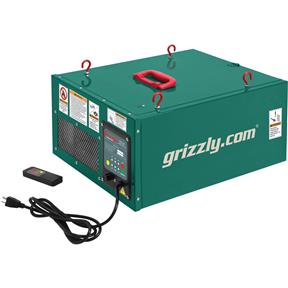
Grizzly builds its own hanging air cleaners and sells them direct, with parts and U.S. phone support. Three units cover most shops:
- Grizzly G0738 3-Speed Hanging Air Filter is the best seller with 300+ reviews. 1/8 HP, 260 to 409 CFM, 1-micron filtration, 62 to 69 dB. Right for a one-car garage or a shop up to about 400 sq ft.
- Grizzly G9956 Heavy-Duty Double Air Filter pushes 1,400 CFM from a 1/3 HP motor with remote control. Pick it for a two-car garage, a 600+ sq ft shop, or anything with a planer and wide-belt sander running daily.
- Grizzly G0572 with Auto Timer and Remote adds a shutoff timer so the unit runs an hour after you leave. It goes on backorder often, so check availability.
Product Comparison Table
Compare key specifications across all 7 air filtration systems:
| Model | Max CFM | Room Size | Filter Stages | Noise (dB) | Remote | Budget |
|---|---|---|---|---|---|---|
| JET AFS-1000C | 1,000 CFM max | Up to 1,100 sq ft | 2-Stage (5/1 micron) | 54 dB (low) | Yes (wired) | Under $1,000 |
| WEN 3410 | 400 CFM max | Up to 400 sq ft | 2-Stage (5/1 micron) | 56 dB (high) | Yes (RF remote) | Under $250 |
| PURISYSTEMS PuriCare 500IG | 500 CFM max | Up to 500 sq ft | 3-Stage + ionizer (5/1 micron) | 52 dB (low) | Yes (RF remote) | Under $250 |
| Powermatic PM1200 | 1,196 CFM max | Up to 1,200 sq ft | 2-Stage (5/1 micron) | 50 dB (low) | Yes (wireless) | Under $1,000 |
| DeWALT DWXAF101 | 500 CFM max | Up to 500 sq ft | 2-Stage (5/1 micron) | 55 dB (high) | Yes (remote) | Under $500 |
| JET IAFS-1700 Industrial Air Filtration System | 1,700 CFM max (800 / 1,200 / 1,700) | Large shops | 2-Stage (MERV 8 outer / MERV 12 inner) | Not listed | Yes (RF, 1-9 hr timer) | Under $2,500 |
| POWERTEC AF4001C | 400 CFM max | Up to 400 sq ft | 2-Stage (5/1 micron) | 58 dB (high) | Yes (RF remote) | Under $250 |
| Grizzly G0738 | 409 CFM max (260 / 362 / 409) | See spec sheet | 2-Stage (5/1 micron) | Not listed | Yes (IR remote, 1/2/4 hr timer) | See Grizzly |
Detailed Reviews

JET AFS-1000C
Ceiling-MountThe JET AFS-1000C is the current model of the most trusted ceiling-mount air filtration system for woodworking shops in the one-car to two-car garage size range. The filter stages capture particles down to 1 micron, and the wired remote control lets you adjust three fan speeds without leaving your workstation. The programmable delay shutoff runs the system for up to 4 hours after you leave, continuing to clean air while you are gone.
Pros
- Industry-leading reputation among woodworkers
- 3-stage filtration down to 1 micron
- Programmable 2-4 hour auto shutoff
- Wired remote for convenient speed control
- Three fan speed settings
- Filter replacement parts widely available
Cons
- Wired remote requires routing cable; not wireless
- Outer filter requires frequent cleaning in heavy use
- Noise at high speed is noticeable
- Mounting hardware is basic
Our Verdict
The JET AFS-1000C earns its reputation as the best overall workshop air filtration system. It is the unit most professional and serious hobby woodworkers install and recommend. If you buy one air filtration unit for your shop, make it the AFS-1000C.
WEN 3410
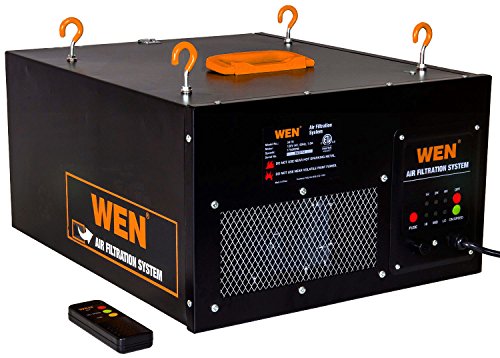
Ceiling-MountThe WEN 3410 is the best-value entry point for workshop air filtration. It covers shops up to 400 square feet and uses a 3-stage filter system to capture particles down to 1 micron. The compact footprint installs in small shops where a larger unit would be impractical. At $200, it dramatically improves air quality over running no filtration at all.
Pros
- Outstanding value at well under $200
- Includes an RF remote for speed changes without a ladder
- Compact size fits small and irregular spaces
- 2-stage filtration catches 1-micron particles
- Easy installation with included mounting hardware
- Quiet enough for continuous background use
Cons
- 400 CFM limits effectiveness in larger shops
- Two filter stages rather than three
- No auto air-quality sensing mode
- Fan noise at high speed is louder than competitors
Our Verdict
The WEN 3410 is the right choice when budget is the primary consideration. It provides genuine air quality improvement in small shops at a price that removes all barriers to entry, and the included RF remote is a feature competitors often charge much more for. Pair it with good dust collection practices and it protects your lungs effectively.

PURISYSTEMS PuriCare 500IG
Ceiling-MountThe PURISYSTEMS PuriCare 500IG hits a compelling price point between the WEN 3410 and the premium JET while adding a wireless RF remote, a built-in ionizer, and three fan speeds (350/450/500 CFM). The 500 CFM capacity covers medium workshops up to 500 square feet, and the quiet low-speed setting makes it comfortable to run continuously without distraction.
Pros
- Wireless RF remote included
- Built-in ionizer helps drop the finest airborne particles
- Three fan speeds (350/450/500 CFM)
- Strong value for a remote-equipped unit
- Stable ceiling mount hardware
- Covers shops up to 500 square feet
Cons
- 500 CFM max limits use in larger shops
- Less brand recognition than JET or Powermatic
- Wireless remote signal range is limited
- Replacement filters can be harder to source locally
Our Verdict
The PURISYSTEMS PuriCare 500IG is the best value-to-performance air filtration system for medium shops. The wireless remote and ionizer are genuine quality-of-life improvements over the wired JET at a much lower price point. If your shop is 400-500 square feet, the PuriCare 500IG is worth the modest premium over the WEN.
Powermatic PM1200
Ceiling-MountThe Powermatic PM1200 is the premium choice for serious woodworking shops. The quietest unit in its class at 50 dB on low speed, the PM1200 can run continuously during operation without interfering with concentration or communication. The 1,200 CFM capacity with a wireless remote, five fan speeds, and a 4-hour timer make it the most feature-complete unit in this review.
Pros
- Quietest operation in its class at 50 dB on low
- 5 fan speed settings for precise control
- Wireless remote with 4-hour programmable timer
- 1,200 CFM handles large shops
- Powermatic brand quality and warranty
- Low-maintenance filter design
Cons
- Premium price under $1,000
- Overkill for shops under 500 square feet
- Replacement filters more expensive than JET
- Heavy unit requires strong mounting points
Our Verdict
The Powermatic PM1200 is the best air filtration system for professional woodworking shops and serious hobbyists who want the quietest, most capable unit available. The premium is justified by the noise reduction alone for anyone spending long hours in the shop.
DeWALT DWXAF101
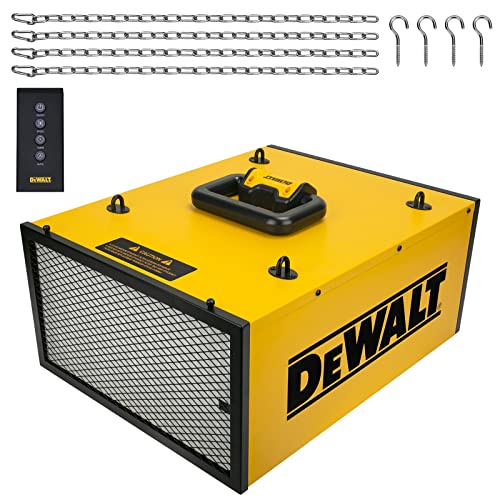
Ceiling-MountThe DeWALT DWXAF101 is a compact, remote-controlled hanging air filtration unit well suited to small and mid-size woodworking spaces. The 2-stage filter system captures particles down to 1 micron and the slim housing installs in spaces where the larger JET or Powermatic would be impractical. The trusted DeWALT name and wide retail availability make parts and replacement filters easy to source.
Pros
- Compact hanging housing fits tight spaces
- 2-stage filtration captures 1-micron particles
- Includes a 3-speed remote control
- Trusted DeWALT brand with wide parts availability
- Simple and reliable motor design
- Good value under $300
Cons
- 500 CFM suits small to mid-size shops only
- Two filter stages rather than three
- Louder than Powermatic at comparable CFM
- Basic mounting hardware
Our Verdict
The DeWALT DWXAF101 is a solid budget option from a reliable brand. It works best in smaller shops where budget matters, and unlike many units at this price it ships with a remote. The wide DeWALT retail network makes long-term filter ownership hassle-free.

JET IAFS-1700 Industrial Air Filtration System
Ceiling-Mount IndustrialThe JET IAFS-1700 replaces the JET AFS-2000 in this guide after the AFS-2000 went out of stock on Amazon. It matches the AFS-2000 on airflow at 1,700 CFM, runs on 115V with a 1/3 HP enclosed ball-bearing motor, and offers three speeds (800, 1,200 and 1,700 CFM) with an RF remote whose timer shuts it off after 1 to 9 hours. JET builds it for both woodworking and metalworking shops: the washable outer filter is MERV 8 and the inner filter is MERV 12, with a slot for an optional charcoal filter. The trade-off is fineness: JET rates the inner filter at 99 percent on 8 to 10 micron particles, where the AFS-2000 inner filter was rated for 1-micron particles.
Pros
- 1,700 CFM on high, the same as the AFS-2000
- Three speeds: 800, 1,200 and 1,700 CFM
- RF remote with a 1 to 9 hour auto-off timer
- Washable MERV 8 outer filter plus MERV 12 inner filter
- Extra slot for an optional charcoal odor filter
- Runs on a standard 115V circuit
Cons
- Filter rating targets 8 to 10 micron particles, coarser than 1-micron woodworking units
- more than the AFS-2000 cost
- Large and heavy; needs solid ceiling mounting
- Overkill for shops under about 800 square feet
Our Verdict
The JET IAFS-1700 is the in-stock choice for large shops that need 1,700 CFM from a single unit, and it suits mixed wood and metal shops that also deal with fumes and mist. For the finest wood dust, pair it with dust collection at the source, or run two 1-micron units such as the JET AFS-1000C in place of one big one.
POWERTEC AF4001C
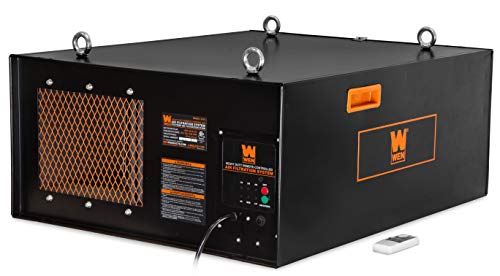
Ceiling-MountThe POWERTEC AF4001C is the lowest-cost remote-equipped entry point for ceiling-mounted workshop air filtration. It runs three fan speeds (300/350/400 CFM), captures particles down to 1 micron, and ships with extra inner and outer filters so you have spares from day one. It is not comparable to JET or Powermatic in build quality or noise, but at under $250 it is dramatically better than no filtration at all.
Pros
- Among the most affordable remote-equipped units
- Includes spare inner and outer filters out of the box
- RF remote for speed changes without a ladder
- Good for small hobby spaces and workrooms
- Easy installation
- Functional for shops up to 400 square feet
Cons
- Build quality reflects the budget price point
- Loud at high speed
- Two filter stages rather than three
- Filter replacement consistency can vary
- Limited to small spaces at 400 CFM
Our Verdict
The POWERTEC AF4001C is the right choice when keeping cost low is the priority but you still want a remote and spare filters. It provides real filtration in a small shop or garage workspace and should not be dismissed because of the price. For a larger room or a quieter motor, step up to the PURISYSTEMS PuriCare 500IG or the JET.

Photo via Unsplash
Air Filtration for a Small Workshop
A small shop needs less airflow than the big-shop numbers in most reviews suggest. Size an ambient air cleaner by air changes per hour: multiply floor area by ceiling height to get cubic feet, multiply by 6 to 8 air changes per hour, then divide by 60 for the CFM you need on the unit's low or middle speed.
- One-car garage (about 240 sq ft, 8 ft ceiling): 1,920 cu ft, so roughly 200 to 260 CFM. A single 400 CFM-class unit like the WEN 3410 or the Grizzly G0738 covers it on low speed, which keeps noise down.
- Half of a two-car garage or a 10x20 shed (about 200 sq ft): same class of unit. Mount it diagonally opposite the door so air circulates in a loop instead of short-cycling.
- Basement shop with a 7 ft ceiling (about 300 sq ft): 2,100 cu ft, so 210 to 280 CFM. Low ceilings favor a hanging unit over a portable floor model because floor space is the constraint.
Run the unit on high for 15 minutes after sanding, then drop to low. If you do not yet have tool-point collection, start there. The dust collection calculator sizes the collector by your tool list, and the air cleaner handles the fine dust that escapes it.
Workshop Air Filtration Buying Guide
An air filtration system is not optional safety equipment for a serious woodworking shop. Here is what to evaluate when choosing one:
🔗 Air cleaners catch what the collector misses. Size the collector itself with the dust collector CFM chart and the dust collector duct size calculator.
Frequently Asked Questions
Do I need an air filtration system if I already have a dust collector?
Yes. Dust collectors capture chips and large particles at the source but even the best dust collector exhausts fine particles back into the shop air. Particles under 10 microns, which are the most dangerous to lung health, pass through standard dust collector bags and filters. An air filtration system continuously scrubs these fine particles from the ambient air, working in conjunction with your dust collection system for complete protection.
What CFM do I need for my workshop size?
A general rule is to cycle all the air in your shop at least 6-10 times per hour. Multiply your shop square footage by ceiling height to get cubic feet, then divide by 6 to get the minimum CFM needed for 10 air changes per hour. For example, a 400 square foot shop with 9-foot ceilings needs a minimum 600 CFM unit. Use our Dust Collection Calculator for precise sizing based on your specific shop dimensions.
Where should I mount a workshop air filtration system?
Mount ceiling air filtration units as close to the center of your shop as possible to maximize air circulation. Position the unit so airflow blows across your primary work areas. Mount at ceiling height or within 12-18 inches of the ceiling to capture rising fine dust particles. Avoid mounting in corners or directly above stationary machines where physical dust collection is already present.
How often should I change air filtration filters?
Outer bag filters should be cleaned by shaking or vacuuming every 2-4 weeks depending on shop activity. Inner cartridge filters typically last 6-12 months before replacement. Some units have filter life indicators. Running a clogged filter reduces airflow and filtration effectiveness significantly. Replacement filter costs range from $30-100 per set depending on the unit.
What micron rating should I look for in an air filtration system?
Look for a unit with a final filter rated at 1 micron or finer. Wood dust particles in the 0.5-10 micron range are the most hazardous to respiratory health because they penetrate deep into lung tissue. Standard outer bag filters catch 5-30 micron particles. The inner cartridge filter in a 2 or 3-stage system captures down to 1 micron, and HEPA filters capture 0.3 micron particles at 99.97% efficiency.
Related Calculators & Resources
Use these tools to complete your workshop air quality setup:
As an Amazon Associate and Grizzly Industrial affiliate, WorkshopCalc earns from qualifying purchases. Our recommendations are based on research into specifications, pricing, and verified owner reviews, not hands-on testing. We only recommend products we believe provide genuine value to workshop owners and woodworkers.