Save your calculations offline — Get the Workshop Planner Spreadsheet ($29)

Dust Collector CFM Chart

Dust collection ductwork and a cyclone separator in a woodworking shop

Photo via Unsplash

The airflow (CFM) each shop machine needs for effective dust capture, the minimum CFM to keep each duct size clearing, and how to size a dust collector for your largest tool. Use it as a reference, then run the numbers in our calculator.
⚡ Quick Answer

Most stationary tools need 350–400 CFM at the machine for good dust capture — small tools like sanders and a router table around 350 CFM, planers and jointers 400–550 CFM, and large drum sanders or big cabinet saws 600+ CFM. By collector power, a 1 HP single-stage unit moves about 650–800 CFM, a 2 HP unit 1,200–1,500 CFM, and a 3 HP cyclone 1,700+ CFM. Size for your single largest machine plus duct and filter losses (pick a collector rated 1.5–2× the machine's requirement), and keep branch velocity at or above 4,000 FPM so chips don't settle in the duct.

CFM Requirements by Machine / Tool

Minimum CFM is the airflow needed for acceptable capture; recommended CFM gives you a margin for fine dust and real-world duct losses. Values are measured at the machine's dust port. Larger or industrial versions of any tool generally need more.

Machine / Tool Minimum CFM Recommended CFM Typical Port Size
Table saw (cabinet)3504004"
Contractor saw350400–4504"
Cabinet saw + overarm guard400550–6004" + 2.5"
Jointer (6" / 8")350400–4504"
Planer (12")4004504"
Planer (15"+)4505504"–5"
Bandsaw3504004"
Drum sander550600+4"
Disc / belt sander3504004"
Router table3003502.5"–4"
Lathe350400–5004"
Miter saw350550+4" (+ hood)
Scroll saw1502502.5"
Drill press3003502.5"–4"
CNC router400550–6504"
Downdraft table400600+4"–6"
Small / benchtop sander3003502.5"–4"

CFM by Duct Diameter

This is the minimum airflow each duct size needs to maintain a 4,000 FPM branch velocity — the speed required to keep wood chips entrained in the air instead of dropping out and clogging the line. If your collector can't deliver this CFM through a given pipe size, the duct is effectively too big.

Duct Diameter Minimum CFM (≥4,000 FPM)
4"~350 CFM
5"~545 CFM
6"~785 CFM
7"~1,070 CFM
8"~1,400 CFM

Note: 4,000 FPM is the standard target for horizontal branch runs carrying chips. Vertical runs and clean-air main lines can run lower (around 3,500 FPM) without dropout.

How to Size Your Dust Collector

Sizing comes down to one principle: a hobby or one-man shop collects from one machine at a time, so the collector only has to satisfy your single biggest tool — plus everything the air has to fight through to get there.

  1. Find your largest single machine's CFM. From the chart above, identify the highest recommended CFM among the tools you actually own. That number, not the sum of all tools, sets your target.
  2. Account for duct and filter losses. A collector's rated CFM is measured with no ductwork. By the time air travels through hose, pipe, elbows, and the filter, real airflow at the port drops substantially. Rule of thumb: choose a collector rated 1.5–2× your largest machine's requirement so the delivered CFM stays adequate.
  3. Run one machine at a time with blast gates. Open only the gate for the tool in use. This concentrates all available airflow at a single port instead of splitting it across the system.
  4. Keep runs short and minimize elbows. Use smooth-wall metal duct over flex hose where possible, size the main line to your collector's inlet, and avoid sharp 90° bends — each one costs CFM. Match branch sizes to the CFM-by-duct table above to keep velocity up.

CFM vs. Static Pressure

These are the two numbers that define a dust collector, and they pull against each other:

CFM (Volume)

Cubic feet per minute — how much air the collector moves. More CFM means more dust and chips carried away per second. It's the headline spec, but it's measured with no resistance attached.

Static Pressure (Resistance)

Measured in inches of water gauge (in. w.g.) — the resistance the collector must overcome from hose, duct, elbows, and filters. Long or restrictive systems demand high static pressure; if the collector can't supply it, CFM at the tool collapses.

A unit advertising big CFM but weak static-pressure capability will look great on a 5-foot hose and disappoint on a real ducted system. When comparing collectors, check the fan curve — how much CFM survives at the static pressure your ductwork creates.

Recommended Dust Collection Gear

The right collector and a clean duct setup make the difference between a dusty shop and a healthy one. These are the picks we trust for matching the CFM numbers in the chart above. All links are affiliate links — we may earn a commission at no cost to you.

Dust Collector

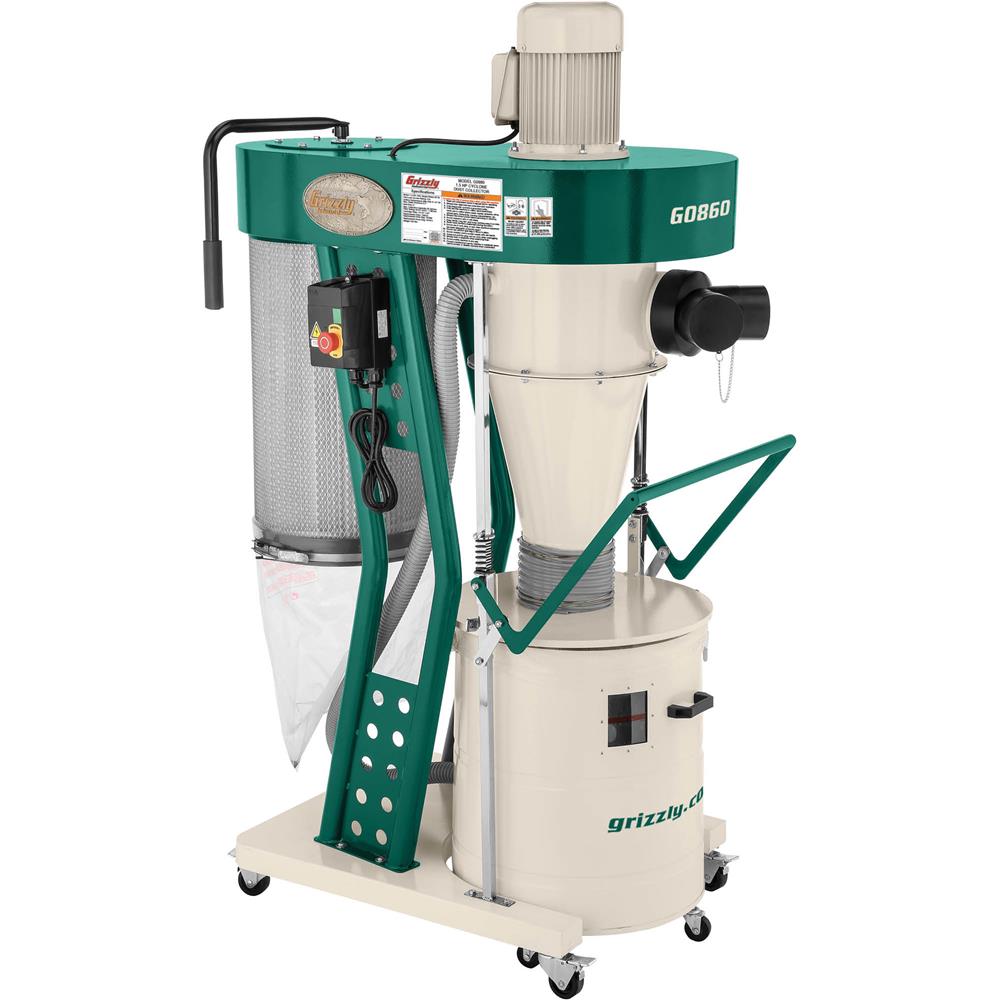
1.5–2 HP Single-Stage Collector

★★★★★ 4.7/5
Best for One-Man Shops
~1,200–1,500 CFM 4"–6" Inlet Canister Option
  • Enough airflow to feed any single machine in the chart
  • Handles a table saw, planer, jointer, and bandsaw on one circuit
  • Canister filter upgrade captures fine dust down to 1 micron
  • Single-stage simplicity with room to add a separator
Oneida

Dust Deputy Cyclone Separator

★★★★★ 4.8/5
Best Pre-Separator
Cyclonic 99%+ Separation Bolt-On
  • Drops chips into a bin before they reach the filter
  • Keeps suction strong by preventing filter clogging
  • Works ahead of a shop vac or single-stage collector
  • Dramatically reduces filter cleaning frequency
Ductwork

4" Flexible Dust Collection Hose

★★★★☆ 4.5/5
Standard Port Size
4" Diameter Clear PVC Cut to Length
  • Fits the 4" ports found on most stationary tools
  • 4" duct carries ~350 CFM at proper branch velocity
  • Keep runs short — flex hose costs more CFM than metal
  • Clear wall lets you spot clogs at a glance
Ductwork

4" Blast Gate Kit

★★★★☆ 4.6/5
Max Airflow Per Tool
4" Gates Self-Cleaning Multi-Pack
  • Close every drop except the tool in use
  • Concentrates all CFM at one machine at a time
  • Self-cleaning slot resists chip buildup
  • Essential for any multi-drop duct system
3M

Reusable Respirator / Dust Mask

★★★★★ 4.8/5
Fine Dust Protection
P100 Filters Reusable Comfort Fit
  • No collector captures every micron — protect your lungs
  • P100 filters stop the finest, most harmful dust
  • Comfortable enough for long sanding sessions
  • Replaceable cartridges keep long-term cost low

Frequently Asked Questions

For a one-man shop where only a single machine runs at a time, a 1.5 to 2 HP single-stage collector moving roughly 1,000 to 1,500 CFM (rated, before duct losses) handles most stationary tools including a table saw, jointer, planer, and bandsaw. Size for your single largest machine plus ductwork losses rather than for running several tools at once. If you have a 15-inch+ planer, a wide drum sander, or long duct runs, step up to a 3 HP cyclone (1,700+ CFM) for reliable performance.

A table saw needs roughly 350 to 400 CFM at the dust port for good chip and dust capture, typically through a 4-inch port. Contractor saws with open bases can need more airflow because they leak air, while a fully enclosed cabinet saw captures dust efficiently at around 400 CFM. Adding an overarm blade-guard pickup increases the total to about 550 to 600 CFM if you collect from both the cabinet and the guard.

A 1 HP single-stage dust collector moves roughly 650 to 800 CFM and works for small shops with light-duty tools like sanders, a small bandsaw, or a benchtop planer connected by short 4-inch hose. It is generally underpowered for a full-size planer, jointer, or for any meaningful run of ductwork, where airflow drops quickly due to static pressure losses. For a shop with stationary machines, a 1.5 to 2 HP unit is a better minimum.

CFM (cubic feet per minute) measures the volume of air a collector moves, which determines how much dust and chips it can carry away. Static pressure (measured in inches of water gauge) measures the resistance the system creates from hose, ductwork, elbows, and filters, which the collector must overcome. A collector with high CFM but low static-pressure capability will lose airflow fast on long or restrictive duct runs, so both numbers matter when sizing a system.

Ductwork, flex hose, elbows, and filters all add static pressure that reduces a collector's rated airflow at the tool. Flexible hose and tight elbows are the biggest offenders, and every fitting and foot of run adds resistance. A common rule of thumb is to choose a collector rated at 1.5 to 2 times the CFM your largest machine requires so that real-world airflow at the port stays adequate after these losses. Keeping runs short, using smooth metal duct, and minimizing elbows preserves the most CFM.

A 6-inch or 8-inch jointer needs about 350 to 450 CFM, while a 12-inch planer needs around 400 CFM and a 15-inch or larger planer needs 550 CFM or more because they produce heavy, fast-moving chips. These machines benefit from a 4-inch port (5- to 6-inch on larger industrial models) and a collector with enough static pressure to keep chips moving up the duct rather than settling and clogging.

Related