Best Dust Collectors 2026: Top Cyclone & Single-Stage Picks Ranked
Dust collectors are sized by airflow in CFM, so the first question is how much your largest machine needs, not which brand is on the box. This guide ranks cyclone and single-stage collectors from a 3 HP cyclone at the top of the range to a wall-mounted unit and a shop-vac cyclone add-on under $500. The picks come from manufacturer specifications and verified owner reviews.
Quick Picks: Best Dust Collectors 2026
Short on time? Here are our top recommendations for different needs and budgets:
The best dust collector overall is the Grizzly G0861 2 HP portable cyclone (under $2,500), whose cyclone separation keeps filters clean in a serious shop. For most home workshops, the Shop Fox W1867 1.5 HP cyclone (under $2,500) hits the value sweet spot. Short on space or budget, the Dust Right 650 CFM wall mount (under $500, currently unavailable on Amazon, so check stock) or the Mullet cyclone separator (under $500) that bolts onto your shop vac are the easiest wins. Match CFM to your largest tool, then size up. Calculate your exact CFM. For a one-machine home shop, the Grizzly G0860 1-1/2 HP portable cyclone (868 CFM at 1.8 in static pressure with a 1 micron canister filter) is the direct-buy pick; on Amazon the closest match is the Shop Fox W1867 1.5 HP cyclone.
🎄 Shopping the sale? See our Black Friday dust collector deals guide for what is worth buying.
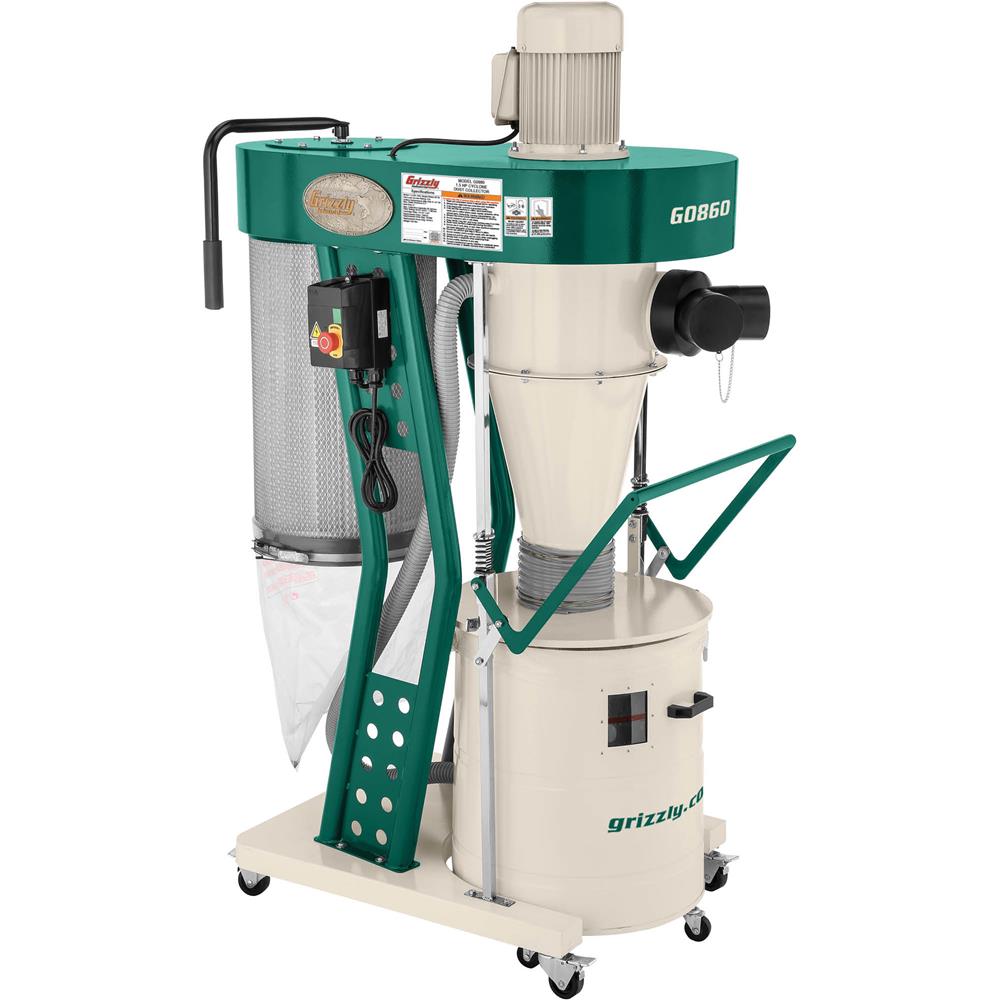
Prefer to buy direct? These Grizzly Industrial collectors are frequently priced lower factory-direct than through a reseller, with full parts availability and U.S. support. Match the CFM to your largest tool, then size up.
G0860 1-1/2 HP Cyclone → G0548ZP 2 HP Canister → G0441 3 HP Cyclone →
Weighing it against an Amazon-sold machine? See Grizzly G0860 vs Laguna D|Flux; Grizzly G0785 vs Rockler Dust Right 650, or every Grizzly vs Amazon comparison.
Best Dust Collector by CFM
Pick a dust collector by the CFM your biggest tool needs, then size up for the duct run. Our dust collection calculator uses 400 CFM for a table saw, 450 for a planer, 400 for a jointer and 350 for a bandsaw, and it warns that a collector rated near 1,200 CFM can deliver closer to 600 once it is pulling through ductwork. So the rated number is a ceiling, not a promise. The Grizzly G0861 2 HP cyclone (under $2,500) is the pick when several tools share one collector, the Shop Fox W1867 (under $2,500) is the sweet spot for a home shop, and the POWERTEC 1 HP (under $500) is the budget single-machine pick.
| Biggest tool on the collector | CFM to plan for | Collector class | Pick | Budget |
|---|---|---|---|---|
| Bandsaw or a single small machine | 350 CFM (bandsaw) | 1 HP wall mount, around 500 CFM | Grizzly G0785 (537 CFM per listing) | Under $1,000 |
| Table saw or jointer, one machine at a time | 400 CFM | 1 HP single stage, about 800 CFM | POWERTEC 1 HP (800 CFM per listing) | Under $500 |
| Planer plus table saw on a duct run | 450 CFM at the planer | 1.5 HP cyclone | Shop Fox W1867 | Under $2,500 |
| Several tools, 2-car garage, full ductwork | Largest tool plus margin | 2 HP cyclone | Grizzly G0861 | Under $2,500 |
| Shop vac and small tools | Whatever the vac moves | Cyclone separator | Mullet separator | Under $500 |
Amazon listings do not always state a CFM, so CFM figures above come from the listing where one is shown (537 CFM for the G0785, 800 CFM for the POWERTEC) and from our calculator for the tools. Check the maker's specification sheet for the rated figure on the others. Moving the collector around the shop? See the best mobile dust collectors, and plan the ductwork with the duct sizing calculator and our dust collection system guide.
Buying a dust collector around Black Friday
Dust collectors are heavy, freight-shipped items and a category worth watching, but we do not know which models will be marked down, so we do not promise a discount. Settle the CFM first, set a ceiling for the exact model, and check price on the day you buy. Shopping for a woodworker? See the gifts for woodworkers guide.
How We Evaluated
Our Evaluation Criteria
We compared each dust collector on the metrics that matter most to woodworkers: CFM, filtration quality, build construction, noise levels, and overall value for money.
CFM Performance
Stated CFM and how it holds up through standard ductwork, from manufacturer data and owner reports
Filtration Quality
Micron rating, filter area, and fine dust capture efficiency
Build Quality
Motor construction, impeller design, housing durability
Value for Money
Performance relative to price point and included accessories
Detailed Product Reviews
High-Speed Cyclone Dust Separator
Best Shop-Vac Add-OnThe Mullet is a high-speed cyclone separator that bolts onto the shop vacuum or collector you already own. It spins debris into a bin before it reaches your filter, so suction stays strong and you empty the filter far less often. For a hobbyist or garage shop, it is the cheapest way to add real cyclone performance.
Pros
- Adds cyclone separation to any shop vac or collector
- Keeps suction strong by stopping clogs
- Inexpensive entry into cyclone performance
- Compact and easy to mount
Cons
- Needs an existing vacuum or collector
- Bin capacity limits run time before emptying
- Not a standalone collector
650 CFM Wall Mount Dust Collector
Best Wall MountThe Dust Right wall mount frees up floor space while still moving 650 CFM, enough for a single tool in a small or mid-size shop. It hangs on the wall, runs on standard household power, and keeps your floor clear for machines.
Pros
- 650 CFM in a wall-mounted, space-saving body
- Frees up valuable floor space
- Runs on a standard outlet
- Good fit for one-tool small shops
Cons
- Single-tool capacity, not whole-shop ducting
- Wall mounting required
- Bag empties more often than drum units
G0785 1 HP Wall-Mount Dust Collector with Canister Filter
The Grizzly G0785 is a 1 HP wall-mounted collector for shops that want more pull than a shop vac without giving up floor space. The wall design keeps it out of the way, the canister filter captures finer dust than a standard bag, and the 1 HP motor handles benchtop and smaller stationary tools.
Pros
- 1 HP motor with real collecting power
- Canister filter for finer dust capture
- Wall-mounted to save floor space
- A clear step up from a shop vac
Cons
- Wall mounting required
- Single-tool use, not full ducting
- Higher price than basic wall units
W1867 1.5 HP Portable Cyclone
Best Value CycloneThe Shop Fox W1867 is a portable 1.5 HP cyclone that rolls between tools and separates debris into a drum before it hits the filter. It is the value entry into true cyclone collection, handling planers, table saws, and jointers in a one-person shop.
Pros
- True cyclone separation at a value price
- 1.5 HP handles most home-shop tools
- Portable, rolls between machines
- Cleaner filters and less maintenance
Cons
- Larger footprint than bag collectors
- Assembly required
- Likely needs a dedicated circuit
G0861 2 HP Portable Cyclone
Best OverallThe Grizzly G0861 steps up to a 2 HP portable cyclone, our best overall pick. The extra power supports longer duct runs and bigger tools while the cyclone design keeps the filter clean. It is the do-everything choice for a serious home shop.
Pros
- 2 HP supports ducting and larger tools
- True cyclone keeps filters clean
- Portable cyclone, rolls where needed
- Strong all-around performer
Cons
- Premium price
- Heavier and larger to move
- 220V likely required
W1869 3 HP Portable Cyclone
Most PowerfulThe Shop Fox W1869 is the most powerful unit here, a 3 HP portable cyclone for demanding shops with extensive ductwork and multiple machines. If you run a busy shop and want maximum airflow, this is the top of the line.
Pros
- 3 HP for the most demanding shops
- Handles long duct runs and multiple tools
- True cyclone separation
- Top-of-line airflow
Cons
- Highest price in this lineup
- Ships in about 9 to 10 days
- Requires 220V and real floor space
Calculate Your Exact CFM Requirements
Use our dust collection calculator to determine exactly what CFM and HP you need based on your specific tools and ductwork layout.
What Size Dust Collector Do I Need?
This is the most common question we get, and the answer depends on your shop size, tools, and ductwork. Here is a quick reference to help you choose the right dust collector size:
| Shop Size | Typical Tools | Minimum HP | Recommended CFM | Our Pick |
|---|---|---|---|---|
| Small (1-car garage) | Benchtop saw, sander | 1 HP | 500-700 CFM | Dust Right 650 CFM Wall Mount |
| Medium (2-car garage) | Table saw, planer, jointer | 1.5 HP | 1,000-1,300 CFM | Shop Fox W1867 1.5 HP Cyclone |
| Large (dedicated shop) | Full stationary tools, ductwork | 2 HP | 1,500-1,700 CFM | Grizzly G0861 2 HP Cyclone |
| Professional (30x40+) | Multiple stations, long duct runs | 3 HP | 1,700+ CFM | Shop Fox W1869 3 HP Cyclone |
| Medium to large (one machine at a time) | Table saw, planer, jointer on a 120V circuit | 1.5 HP | 868 CFM (G0860 rating) | Grizzly G0860 1-1/2 HP Cyclone, 1 micron canister |
Pro Tip: Always size up rather than down. A dust collector running at 70% capacity will last longer, run quieter, and maintain better suction than one running at 100%. If you are between sizes, go with the larger unit, your lungs will thank you. For an exact calculation based on your tools and ductwork layout, use our Dust Collection CFM Calculator.
Complete Buying Guide: What to Look For
Before purchasing a dust collector, understanding these key factors will help you make an informed decision that matches your shop's needs.
CFM (Cubic Feet per Minute)
CFM measures airflow volume and is the primary specification for dust collector performance. Different tools require different CFM levels for effective dust capture:
- Table Saw: 350-450 CFM at the blade guard and cabinet
- Planer: 400-500 CFM - the highest demand tool in most shops
- Jointer: 350-450 CFM depending on size
- Bandsaw: 350-400 CFM for 14-inch and larger
- Router Table: 300-400 CFM
- Miter Saw: 300-350 CFM
Important: Manufacturers often list CFM at the collector inlet. By the time air reaches your tool through 15-20 feet of ductwork with elbows, you may lose 30-50% of that rated CFM. Always size your collector for your highest-demand tool plus ductwork losses.
Horsepower (HP) Rating
HP correlates with the collector's ability to maintain CFM under load and through longer duct runs:
| HP Rating | Typical CFM | Best For |
|---|---|---|
| 3/4 - 1 HP | 500-700 CFM | Small shops, benchtop tools, minimal ductwork |
| 1.5 HP | 1,000-1,300 CFM | Most home woodworking shops, moderate duct runs |
| 2 HP | 1,200-1,700 CFM | Larger shops, longer duct runs, multiple tools |
| 3+ HP | 1,500-2,000+ CFM | Professional shops, extensive ductwork systems |
Filtration: The Critical Health Factor
Filtration quality directly impacts your health. The most dangerous wood dust particles are those under 2.5 microns, which bypass your body's defenses and lodge deep in your lungs.
- 30-micron bags: Standard on budget collectors. Allows most fine dust through. NOT recommended.
- 5-micron bags: Better, but still inadequate for health protection.
- 2-micron bags: Acceptable minimum for hobby use.
- 1-micron filters: Recommended baseline. Captures most harmful particles.
- 0.5-micron or better: Excellent protection. Industry best practice.
Upgrade Your Filtration
If your collector comes with 30-micron bags, upgrading to a 1-micron canister filter ($150-400) is one of the best investments you can make for your health. Do not skip this step.
Single-Stage vs. Two-Stage (Cyclone)
Single-Stage Collectors pass all debris directly through the impeller. They are more affordable ($300-800) and compact, but debris can damage the impeller over time and filters clog faster.
Two-Stage Cyclone Collectors use centrifugal force to separate 99% of debris before it reaches the impeller. Benefits include:
- Extended motor and impeller life
- Filters stay cleaner longer, maintaining suction
- Better overall dust separation
- Easier emptying - just detach the collection drum
Cyclones cost more ($1,200-3,000+) but offer superior long-term value for serious woodworkers who produce significant amounts of chips and dust.
Additional Considerations
- Voltage: 1-1.5 HP units typically run on 110V. Larger 2+ HP units often require 220V, which may need an electrician to install.
- Noise Level: Dust collectors are loud (typically 80-90 dB). Consider placement outside the shop or in an adjacent space if noise is a concern.
- Footprint: Cyclone collectors are taller and require more floor space. Measure your available space before purchasing.
- Mobility: If you need to move the collector around, look for models with casters or mobile bases; see our best mobile dust collector picks.
- Collection Capacity: Larger bins mean less frequent emptying. Consider 30+ gallon capacity for serious use.
Dust collectors for home shops
Match the collector to the shop, not the other way around.
| Home shop | Collector type | Notes |
|---|---|---|
| Garage or hobby shop, one machine at a time | Wall-mount or portable collector with a canister filter | Cheapest and smallest; good for a table saw, sander or bandsaw. |
| Woodworking shop with a planer or jointer | 1.5 to 2 HP portable cyclone | Handles chips and fine dust; needs a 240 volt circuit on larger models. |
| Larger home shop with several machines | 3 HP cyclone with ducting | Needs a dedicated circuit, space for ducting and a blast gate plan. |
Every dust collector needs a dedicated circuit or a check of your wiring, because the motor can draw most of a household circuit. Fine dust is a respiratory hazard that a bag or canister does not fully remove, so wear a respirator. Fine wood dust is also combustible, so keep collectors away from sparks.
Dust collectors for a home shop
Photos and buttons open the current listing.
Dust Right 650 CFM Wall Mount Dust Collector
A small wall-mount collector for one machine at a time.
Check price on AmazonWEN DC1300 Dust Collector with 50-Gallon Bag
A budget single-stage collector on a mobile base.
Check price on AmazonGrizzly G0861 2 HP Portable Cyclone Dust Collector
A home-shop cyclone for planers and jointers.
Check price on AmazonQuick answers
What size dust collector do I need for a home shop?
It depends on the machines you run. Use the dust collection calculator to find the airflow, then pick a collector that delivers it at the end of your duct run.
Do I need a cyclone for a home shop?
Not for one small machine. A cyclone helps when you run a planer or jointer, because it traps most chips before they reach the filter.
Is a shop vac enough for a home shop?
For hand sanders and small tools, yes. For a planer or jointer, you need a dust collector.
Working in a single bay? See dust collection for a one-car garage shop for what fits and how to lay it out.
Frequently Asked Questions
Match the CFM to your biggest tool: about 350 for a bandsaw, 400 for a table saw or jointer and 450 for a planer, then size up for the duct run. The POWERTEC 1 HP lists 800 CFM for single-machine shops, the Shop Fox W1867 1.5 HP cyclone suits a home shop, and the Grizzly G0861 2 HP cyclone suits several tools on one collector.
It can be, but we do not know which models will be marked down and we do not promise a discount. Set a price ceiling for the exact model and check price on the day you buy. These are heavy items that ship by freight, so allow time for delivery.
For a small 1-car garage shop with benchtop tools, a wall-mounted 650 CFM unit like the Dust Right Wall Mount will work. For a 2-car garage with a table saw, planer, and jointer, you want at least 1.5 HP like the Shop Fox W1867 cyclone. Dedicated shops with full ductwork need 2-3 HP, so we recommend the Grizzly G0861 2 HP Cyclone for shops over 400 sq ft. Use our dust collection calculator for an exact sizing recommendation.
For a typical home woodworking shop, you need at least 400-600 CFM at the tool for effective dust collection. A planer requires 400-500 CFM, table saws need 350-450 CFM, and jointers require 350-450 CFM. See our dust collector CFM chart for per-tool numbers, and account for 20-40% CFM loss through ductwork when sizing your collector. Use our dust collection calculator to determine your exact requirements.
A 1 HP dust collector (typically 500-700 CFM) works for small shops with benchtop tools and short duct runs under 10 feet. However, for shops with floor-standing tools like a table saw, planer, or jointer, a 1.5-2 HP collector (1,000-1,500 CFM) is recommended to maintain adequate airflow after ductwork losses.
Single-stage collectors pass all debris directly through the impeller to the collection bag. This is simpler and cheaper but causes impeller wear. Two-stage (cyclone) collectors use centrifugal force to separate 99% of debris before it reaches the impeller, resulting in longer filter life, better filtration, and extended motor lifespan. Cyclones cost more but offer superior performance for serious woodworkers.
Look for 1 micron or better filtration. Standard 30-micron bags let harmful fine dust escape back into your shop. The most dangerous particles are under 2.5 microns, which can lodge deep in your lungs. Upgrade to at least a 1-micron bag or canister filter, with 0.5-micron or better being ideal for health-conscious shops.
Shop vacuums and dust collectors serve different purposes. Shop vacs provide high suction (static pressure) but low airflow (CFM), making them ideal for small ports (2.5 inches or less) and hand-held tools. Dust collectors provide high CFM but lower static pressure, necessary for 4-inch and larger ports on stationary tools. Most well-equipped shops benefit from having both systems.
Budget $300-500 for entry-level 1 HP units suitable for small shops. Mid-range 1.5-2 HP collectors run $500-1,200 and handle most home workshops well. Professional cyclone systems start at $1,500 and can exceed $3,000. Remember that investing in better filtration (1-micron or better) is often more important than raw CFM for protecting your health.
A 2-car garage running a table saw, planer, and jointer needs a 1.5-2 HP collector rated around 1,000-1,500 CFM to hold adequate airflow after ductwork losses. A single-stage 1.5 HP unit handles one machine at a time on short runs; a 2 HP cyclone is the better choice if you add ductwork to multiple stations. Size to your single largest tool's CFM demand, then step up. Our dust collection calculator gives an exact number for your tool list.
A cyclone is not required, but it is a worthwhile upgrade for most shops. A cyclone separates about 99% of chips and dust into a drum before they reach the filter, so suction stays strong, filters last far longer, and the impeller sees less wear. For a single-tool hobby setup a single-stage collector is fine; for a shop running a table saw, planer, and jointer regularly, a cyclone (or a cyclone separator added to a single-stage unit) pays off in maintenance and air quality.
CFM is airflow, not a number you read off a 4-inch port directly. Manufacturers rate a collector's maximum CFM at the inlet with no restriction; real-world CFM at the tool is lower after the 4-inch duct, elbows, and filter. A 4-inch port physically limits flow to roughly 350-400 CFM regardless of motor size, which is why larger tools use 5- or 6-inch ports. To estimate delivered CFM, start from the rated figure and subtract 20-40% for a typical duct run, or use our dust collection calculator.
Final Recommendations
After thorough evaluation, here are our recommendations for different scenarios:
Best Cyclone Dust Collector (Our #1 Pick)
The Grizzly G0861 2 HP Portable Cyclone is our top recommendation for any woodworker ready to invest in a system that lasts. True cyclone separation drops debris into the drum before it reaches the filter, so suction stays strong and maintenance stays low. It rolls between machines and has the power for real ductwork. This is the collector serious woodworkers wish they had bought first.
Best Premium Cyclone (Editor's Choice)
The Shop Fox W1869 3 HP Portable Cyclone is the most powerful unit in this lineup. The 3 HP motor supports long duct runs and multiple stations at once, with the same cyclone separation that keeps filters clean. If you run a busy shop and want maximum airflow, this is the one to own.
Best Overall Single-Stage
The Shop Fox W1867 1.5 HP Cyclone provides the best performance-per-dollar here. It is the value entry into true cyclone collection, handling planers, table saws, and jointers in a one-person shop while keeping filters clean.
Best Budget Dust Collector
The Mullet Cyclone Separator is the smartest budget move: it bolts onto the shop vac you already own and adds real cyclone separation for under $500. For a small shop, the Dust Right 650 CFM wall mount frees up floor space and runs on a standard outlet.
Ready to Size Your System?
Use our Dust Collection Calculator to determine exact CFM requirements based on your tools and ductwork, or read our complete Dust Collection System Guide for ductwork design and installation tips.
Affiliate Disclosure: WorkshopCalc is reader-supported. When you buy through links on our site, we may earn an affiliate commission at no additional cost to you. This helps us maintain and improve our free calculators and guides. We only recommend products we believe provide genuine value to woodworkers.
Related comparisons: Dust collector vs shop vac: WEN DC1300 vs Ridgid 1610RV, Dust collector vs dust extractor: WEN DC1300 vs DeWalt DWV010.
Related buying pages: Best dust collector for a planer and table saw, Laguna bandsaws, table saws and dust collectors lineup, WEN benchtop tools lineup explained.