Dust collection for a one-car garage shop
Size it for your machines first
Use the dust collector calculator: tick your machines, enter the hose length to the farthest one and any elbows, and it returns the CFM and static pressure you need. In a one-car shop with a short hose, most results land between about 400 and 550 CFM, which is 1 HP to 1.5 HP territory. The dust collector CFM chart lists each machine's figure.
One-car garage options at a glance
| Setup | Floor space | Best for | Weak spot |
|---|---|---|---|
| Wall-mount 1 HP collector, one hose moved between tools | None | Table saw, bandsaw, jointer in a tight bay | Hose must reach every machine |
| Mobile 1 HP collector rolled to each tool | About 3 sq ft, parks anywhere | Shops that rearrange often | Bags fill fast on planer work |
| 1.5 HP portable cyclone | About 4 sq ft | Frequent planing, more chips | Draws 15A on 120V, needs its own circuit |
| Shop vac plus cyclone separator | About 2 sq ft | Sanders, routers, track and miter saws | Too little air for planers and jointers |
Layout that works in a single bay
A one-car garage is usually around 12 by 20 feet, and the car door takes one end. Put the collector at the middle of the long wall, so a 10 to 15 foot hose reaches the table saw, bandsaw and planer without crossing a walkway. Keep the hose as straight as you can; every bend and every extra foot of flex hose costs airflow, and the calculator shows how much. Machines on mobile bases can roll to the collector rather than the other way around, which keeps the hose short.
Power matters in a small garage too. A 1 HP collector on 120V draws enough current that it should not share a circuit with a 15 amp table saw; see can I run a table saw on a 15 amp circuit. A 1-1/2 HP cyclone such as the G0860 is listed at 15 amps on 120V, so it needs a circuit of its own. Panel and circuit work is for a licensed electrician, and local code governs.
Fine dust in a closed garage
Collectors catch chips at the machine, but the fine dust that hangs in the air is the health concern, and a small garage with the door shut concentrates it. Choose 1-micron filtration on the collector, run a hanging air filter while you work and for a while after, and wear a fitted respirator for sanding. The best air filtration systems guide covers ceiling units.
Collectors that fit a one-car shop
For the G0785 head to head with a rival wall-mount, read Grizzly G0785 vs Rockler Dust Right 650, and for the cyclone, the Grizzly G0860 review. More models are in the best dust collectors.
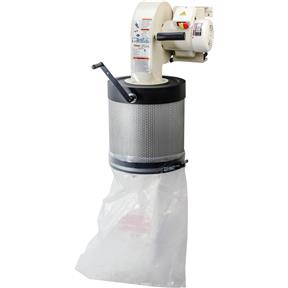
Grizzly G0785 1 HP Wall-Mount Dust Collector with Canister Filter
If floor space is the problem: hangs on the wall; Grizzly lists 537 CFM, a 1-micron canister and a 4 inch inlet, prewired 120V.
Buy direct at GrizzlyPOWERTEC 1 HP 800 CFM Dust Collector with Mobile Base
If you want to roll the collector to each machine: mobile base and 1 micron upper bag per the listing.
See on Amazon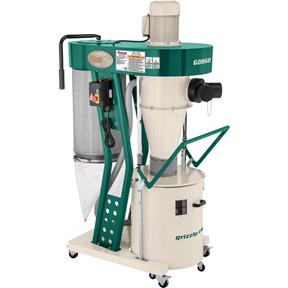
Grizzly G0860 1-1/2 HP Portable Cyclone Dust Collector
If you run a planer often: cyclone separation keeps chips out of the filter; Grizzly lists 868 CFM at 1.8 in static pressure, 1-1/2 HP, 110V, 15A.
Buy direct at GrizzlySkip this if
Your shop is hand tools, a miter saw and sanders only. A good shop vac with a cyclone separator handles those ports better than a collector, and costs less floor space.
Related reading
- Dust collector calculator
- Duct size calculator
- Dust collection system guide
- Small workshop layout guide
Frequently asked questions
Is a 1 HP dust collector enough for a one-car garage?
For one machine at a time on a short hose, usually yes. The site's dust collector chart puts most stationary tools at 350 to 450 CFM at the machine, and a 1 HP unit with a short, straight hose is in that range. Long duct runs and many elbows are what push a small shop to 1.5 or 2 HP.
Should I run ductwork in a one-car garage?
Often not. With the machines a few feet apart, rolling the collector or moving one short hose between tools avoids the static pressure losses of duct, elbows and blast gates. If you do run duct, keep it short and straight and size it with the duct size calculator.
Is a shop vac enough for dust collection?
A shop vac moves little air at high suction, which suits small ports on sanders, routers and track saws. It cannot carry the chip volume from a planer or jointer. Many small shops use both: a vac with a cyclone separator for hand tools and a collector for the big machines.
What filter rating do I need in a small shop?
Fine dust is the health risk, and a small, closed garage concentrates it. Choose a collector with a canister or bag rated about 1 micron, add a hanging air filter, and wear a respirator for sanding. A 30 micron bag lets fine dust back into the room.
Disclosure: WorkshopCalc is an Amazon Associate and a Grizzly Industrial affiliate. We earn from qualifying purchases made through the buttons on this page, at no extra cost to you. Prices are not shown because they change often.