Can I run a table saw on a 15 amp circuit?
Check your saw and circuit
Read the amps on the saw's motor plate or in its manual, add whatever else runs on the same circuit at the same time, and pick the breaker size. The tool applies two rules: the saw alone must stay at or under 80 percent of the breaker, and everything running together must stay under the breaker rating.
Saws that fit your result
The formula. Plug-in limit = 0.8 x breaker amps (NEC 210.23(A)(1)). Total = saw amps + other amps. Verdict: total above the breaker means it will trip; saw above the plug-in limit means the circuit is undersized for the saw; total above 80 percent of the breaker is tight; anything else fits. Start-up surge is not counted, because breakers are built to ride through a brief motor start, but a saw that trips at start-up on a shared circuit is telling you the same thing.
15 amp vs 20 amp circuit at a glance
| Circuit | Single plug-in item limit (80%) | Typical wire | 15 A table saw alone | 15 A saw plus 10 A shop vac |
|---|---|---|---|---|
| 15 amp, 120V | 12 A | 14 AWG copper | Over the limit | Trips (25 A) |
| 20 amp, 120V | 16 A | 12 AWG copper | Fits | Trips (25 A) |
| Two 20 amp circuits | 16 A each | 12 AWG copper | Fits | Fits, one tool per circuit |
Wire sizes are the common pairing for copper branch circuits; the wire gauge chart has the full table. An outlet on a 20 amp circuit may be a 15 amp receptacle, which is allowed when there are several outlets on the circuit, so the outlet shape does not tell you the breaker size. Look at the breaker handle.
Why a 15 amp saw on a 15 amp circuit is a problem
Most 10 inch jobsite saws, including the DeWalt and SKIL models below, are rated 15 amps. That figure is the maximum the motor is designed to pull under load, and in hard rips through thick oak it can get there. On a 15 amp breaker the saw then has no margin, and a second load such as a work light, a radio, a heater or the shop vac connected for dust pushes the circuit past its rating. Garage and basement outlets are often on one shared circuit with a freezer or a door opener, which is the usual reason a saw trips the breaker halfway through a cut.
The practical fix is one dedicated 20 amp, 120V circuit for the saw and a second circuit for dust collection. That is a job for a licensed electrician, who will check whether your panel has room and pull any permit your town requires. If your shop needs a full load count across every machine, run the workshop electrical load calculator, and see the workshop electrical guide for how circuits are usually laid out.
Until the new circuit is in
- Run the saw alone. Unplug or switch off anything else on that circuit, including the shop vac.
- Keep the blade sharp and clean. A dull or pitch-coated blade raises the motor's current draw.
- Feed slower in thick hardwood instead of forcing the cut.
- Plug into the wall. If you must use a cord, size it with the extension cord size chart.
- Never swap a 15 amp breaker for a 20 amp one on the same wire. The wire, not the breaker, sets the safe rating.
Table saws and what circuit they want
All three run on 120V. The DeWalt and SKIL are jobsite saws listed at 15 amps; the Grizzly G0771Z is a 2 HP hybrid that Grizzly lists at 15 amps on 120V. Each one wants a dedicated 20 amp circuit to run with margin. For more choices sized to a garage, see the best table saw for a small shop, and for the G0771Z against Grizzly's 240V cabinet saw, read G0771Z vs G1023RL.
DEWALT DWE7491RS 10-Inch Table Saw with Rolling Stand
If you want the 32-1/2 inch rip and a rolling stand on a dedicated circuit.
See on AmazonSKIL TS6307-00 15 Amp 10-Inch Jobsite Table Saw with Folding Stand
If you are on a 20 amp circuit and want a lighter folding-stand saw.
See on Amazon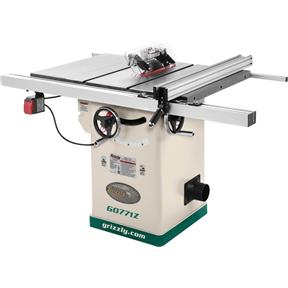
Grizzly G0771Z 10 in. 2 HP 120V Hybrid Table Saw
If you want a stationary hybrid saw that still runs on 120V, sold factory direct.
Buy direct at GrizzlySkip this if
You are buying a 3 HP cabinet saw. Those are 240V machines and the 120V question does not apply; you need a 240V circuit sized from the motor plate, installed by an electrician. Also skip the advice above if you already have a dedicated 20 amp circuit with nothing else on it: a 15 amp saw fits there.
Related reading
Frequently asked questions
Is a 15 amp table saw too much for a 15 amp breaker?
The saw's rating equals the breaker's rating, so there is no room left for anything else on that circuit. The National Electrical Code limits one plug-in item to 80 percent of the circuit rating, which is 12 amps on a 15 amp circuit, so a dedicated 20 amp circuit is the cleaner fit. A licensed electrician should make the call for your panel.
Why does my table saw trip the breaker when it starts?
Motors draw several times their running current for a moment at start-up, and a dull blade or a hard rip raises running current too. If a shop vac, heater or lights share the circuit, the combined load can pass the breaker rating. Run the saw alone first, then have an electrician check the circuit if it still trips.
Can I use an extension cord with a 15 amp table saw?
Only a short, heavy one. Long or thin cords drop voltage, which makes the motor draw more current and run hotter. Use the extension cord size chart on this site to pick the gauge for your length, and plug into a wall outlet whenever you can.
Do I need a 240V circuit for a table saw?
Not for a 120V jobsite or hybrid saw rated 15 amps. Cabinet saws with 3 HP motors are usually 240V only and need a 240V circuit installed by an electrician. Check the motor plate before you buy.
Can the saw and the dust collector share one 20 amp circuit?
Usually not. A 15 amp saw plus a shop vac or small collector drawing 8 to 12 amps adds up to more than 20 amps. Give the collector its own circuit, and let an electrician decide how many circuits your panel can support.
Electrical figures are general guidance from the National Electrical Code, not advice for your building. Panel and circuit work is for a licensed electrician, and local code governs.
Disclosure: WorkshopCalc is an Amazon Associate and a Grizzly Industrial affiliate. We earn from qualifying purchases made through the buttons on this page, at no extra cost to you. Prices are not shown because they change often.