Best Extension Cords for Power Tools (2026)
The wrong extension cord costs you power at the tool and heat in the cord. The right one is simply thick enough for the amp draw and the distance. This guide ranks seven cords and reels by gauge, length and build, using the same amp-and-length rules as our extension cord size chart: 12 gauge for most 15-amp tools up to 50 feet, 10 gauge for longer runs and heavy loads.
For most power tools, the best extension cord is a 50 foot 12 gauge cord like the Southwire 2588SW0002 (about $63): 12/3 SJTW, lighted end, reinforced blades. For 100 foot runs or heavy loads like compressors and table saws, step up to 10 gauge, such as the POWGRN 100 ft 10 AWG (about $136). For a shop that wants cords off the floor, the CRAFTSMAN 100 ft contractor reel (about $180, 12 AWG, 4 outlets) or the wall-mount DEWENWILS 40 ft 12 AWG reel (about $87) keep things tidy.
Quick Picks: Best Extension Cords for Power Tools 2026
Short on time? These are the picks, from the buy-once option down to the budget set. Every card links to the current Amazon listing.
How We Picked
What we compared
We compared each cord on wire gauge and length against our extension cord size chart, jacket type (SJTW, SJTOW) and whether it is rated for outdoor use, safety listing (UL or ETL), amp and watt rating, plugs and outlets, and storage. Specs come from manufacturer listings, and we weighed recurring themes in verified owner reviews. We did not load-test these cords.
Gauge for the length
12 AWG to 50 ft, 10 AWG beyond, per our chart
Jacket and rating
SJTW or SJTOW, outdoor rating, UL or ETL listing
Plugs and outlets
Lighted ends, reinforced blades, multi-outlet ends
Storage
Reels and wall mounts that keep cords off the floor
Extension Cord Comparison Table
| Cord | Gauge | Length | Jacket / Listing | Best For | Price (approx.) |
|---|---|---|---|---|---|
| Southwire 50 ft 12/3 SJTW Extension Cord | 12 AWG | 50 ft | SJTW | Most power tools | about $63 |
| POWGRN 100 ft 10 AWG Outdoor Extension Cord | 10 AWG | 100 ft | cETL listed | Long runs, heavy loads | about $136 |
| CRAFTSMAN 100 ft Contractor Cord Reel, 4 Outlets | 12 AWG | 100 ft | See listing | Contractors, big shops | about $180 |
| DEWENWILS 40 ft 12 AWG Retractable Cord Reel | 12 AWG | 40 ft + 4.5 ft lead | SJTOW, UL listed | Garage ceiling or wall | about $87 |
| Iron Forge Cable 50 ft 10 Gauge Multi-Outlet Cord | 10 AWG | 50 ft | SJTW | Several tools at once | about $79 |
| POWGRN 100 ft 12/3 Outdoor Extension Cord | 12 AWG | 100 ft | SJTW, ETL listed | Long reach, lighter loads | about $79 |
| POWGRN 50 ft 12/3 Outdoor Extension Cord | 12 AWG | 50 ft | SJTW, ETL listed | Budget 12 gauge | about $44 |
Detailed Reviews
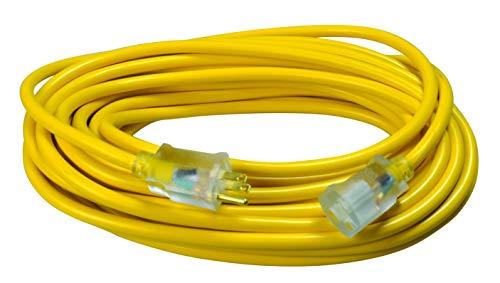
A 50 foot 12 gauge cord runs a 15-amp tool like a circular saw, miter saw or shop vac with acceptable voltage drop, which makes it the one cord most shops should own. Southwire is a major US wire maker, and this cord uses a 12/3 SJTW water-resistant vinyl jacket that resists moisture, abrasion and sunlight, reinforced blades that resist bending, and a lighted end that shows power is on. The yellow jacket is easy to see on a jobsite floor.
Pros
- Right gauge for 15 A tools to 50 ft
- Water and sunlight resistant jacket
- Reinforced blades
- Lighted end
Cons
- Single outlet
- Too thin for 100 ft runs at full load

At 100 feet, a 12 gauge cord starts to cost you real voltage under a full 15-amp load. A 10 gauge cord is the fix. POWGRN lists this 100 foot 10 AWG cord at 15 amps, 125 volts and 1875 watts, cETL listed, with a lighted end and strain relief, and says each cord passes a 1500 volt test. Use it for a compressor in the driveway, a table saw at the far end of the garage, or a jobsite where the outlet is a long way off.
Pros
- 10 gauge for 100 ft runs
- cETL listed
- Lighted end
- Strain relief at the plugs
Cons
- Heavy and bulky to coil
- Overkill for short runs

A reel keeps 100 feet of cord from turning into a tangle on the floor. CRAFTSMAN lists this contractor reel with a heavy-duty steel drum, a ridged carry handle, four grounded outlets at the reel and a high-visibility 12 AWG cord. The four outlets let you run a light, a charger and a tool from one reel. Unwind the full cord when running a heavy load; a coiled cord on a drum holds heat.
Pros
- Steel drum stands up to jobsite use
- Four outlets at the reel
- 12 AWG cord
- Easy to carry and store
Cons
- Unwind fully for heavy loads
- Stock has been limited
- 12 AWG at 100 ft limits full-load use

A retractable reel on the garage wall or ceiling puts power anywhere in a two-car garage and pulls the cord back when you are done. DEWENWILS lists a 40 foot 12/3 SJTOW cord rated 15 amps and 1875 watts, UL listed, with a triple-outlet end and indicator light, a 4.5 foot lead-in, and an auto-guide rewind to avoid kinks. SJTOW jackets resist oil and water, but DEWENWILS rates the reel itself for indoor or dry locations.
Pros
- Auto-retracting, stays off the floor
- 12 gauge
- UL listed
- Triple outlet end
Cons
- Indoor or dry location only
- 40 ft reach

A 10 gauge cord with a three-outlet end is the heavy-duty version of a power strip on a cord. Iron Forge Cable lists it for construction sites, compressors, saws and wet/dry vacs, with nickel-coated reinforced blades. Remember that the outlets share one cord: three tools running at once still have to stay within the cord and circuit rating.
Pros
- 10 gauge at 50 ft
- Three outlets
- Reinforced blades
Cons
- Outlets share one 15 A cord
- Stock can be limited

If you need 100 feet of reach but mostly run lighter loads like string lights, a trimmer or a drill, a 12 gauge 100 foot cord costs about $57 less than the 10 gauge. POWGRN lists 12/3 SJTW, 15 amps, 1875 watts, ETL and cETL listed, with a lighted end. For a full 15-amp saw or compressor at 100 feet, the 10 gauge cord is the safer choice.
Pros
- 100 ft for about $79
- ETL listed
- Lighted end
Cons
- Voltage drop at full 15 A load over 100 ft

The budget version of our top pick. POWGRN lists 12/3 SJTW, 15 amps and 1875 watts, NEMA 5-15 plug and receptacle, ETL and cETL listed, a lighted end, and a jacket it rates IP65 and resistant to heat and cold. It is the right gauge for the 50 foot column of our chart at about two-thirds the price of the Southwire.
Pros
- 12 gauge for about $44
- ETL listed
- Lighted end
Cons
- Less established brand than Southwire
How to Choose an Extension Cord
Two numbers decide the cord: the amps on the tool's nameplate and the length you need. Our extension cord size chart turns those into a gauge.
Gauge: lower number, thicker wire
AWG runs backwards: 10 gauge is thicker than 12, which is thicker than 14. Thicker wire has less resistance, so less voltage is lost over the length and the cord runs cooler. For a 15-amp tool, use 12 gauge up to 50 feet and 10 gauge beyond that. A 14 gauge cord is fine for lights and chargers, not saws and compressors.
Length: buy what you need
Every extra foot adds resistance. A 25 foot 12 gauge cord delivers more voltage to the tool than a 100 foot 12 gauge cord. Buy the shortest cord that reaches, and a second, longer cord for the occasional far outlet.
Jacket letters
S means service grade, J means junior service (300 volts), T means thermoplastic, O means oil resistant, and W means rated for outdoor use. SJTW is the common outdoor tool cord; SJTOW adds oil resistance, useful in a garage.
Listing and plugs
Look for a UL or ETL listing, reinforced or nickel-plated blades, molded plugs and strain relief. Lighted ends are a small but real convenience. Never remove the ground pin.
Better than a cord: a circuit
If you run a table saw, dust collector or compressor from the same spot every day, a dedicated circuit beats any cord. Our workshop electrical guide and electrical load calculator help you plan it.
Frequently Asked Questions
For most 15-amp power tools, a 50 foot 12 gauge cord is the best all-round choice, such as the Southwire 12/3 SJTW. For 100 foot runs or heavy loads, use a 10 gauge cord like the POWGRN 100 ft 10 AWG.
Use 12 gauge up to 50 feet and 10 gauge for 100 feet. A 14 gauge cord is only suitable for short runs at 15 amps, and 16 gauge is for light loads. Our extension cord size chart covers other amp ratings and lengths.
10 gauge is thicker and carries current over longer distances with less voltage drop and heat, but it is heavier and costs more. 12 gauge is enough for 15-amp tools up to about 50 feet. Choose 10 gauge for 100 foot runs, compressors and table saws.
Ideally none: compressor makers usually recommend running a longer air hose instead of an extension cord. If you must, use the shortest 10 or 12 gauge cord that reaches, and never a light-duty cord.
No. Use a cord rated for outdoor use, marked W in the jacket code (such as SJTW), and plug it into a GFCI-protected outlet.
Final Recommendations
Our picks by use.
Best overall: Southwire 50 ft 12/3
The right gauge for most 15-amp tools at 50 feet, with a tough water-resistant jacket and a lighted end.
Long runs: POWGRN 100 ft 10 AWG
10 gauge for compressors, table saws and any 100 foot run under real load.
Cord reel: CRAFTSMAN 100 ft contractor reel
A steel-drum reel with four outlets for jobsites and big shops.
Wall-mount: DEWENWILS 40 ft reel
An auto-retracting 12 gauge reel that keeps a garage floor clear.
Check the gauge before you plug in
Our extension cord size chart gives the right gauge for any amp rating and length, and the wire gauge chart covers permanent wiring.
How we research: WorkshopCalc does not bench-test the tools in this guide. Picks are based on manufacturer specifications, published standards and certifications, and patterns in verified owner reviews. Prices are approximate, were checked in 2026, and change often. This guide is researched general information, not professional advice; for permanent wiring and new circuits, consult a licensed electrician and your local code.
Affiliate Disclosure: WorkshopCalc is reader-supported. When you buy through links on our site, we may earn an affiliate commission at no additional cost to you. As an Amazon Associate, WorkshopCalc earns from qualifying purchases.