The right drill speed keeps your bits sharp, your holes clean, and your material unburned. The rule is simple: small bits and soft materials run fast; large bits and hard materials run slow. The charts below give recommended RPM by bit diameter for each material, based on standard surface-speed (SFM) values for high-speed-steel (HSS) bits. Round to the nearest pulley setting on your drill press.
As a rule of thumb: softwood ~1/4" bit at 3000 RPM, 1/2" at 1500 RPM, 1" at 750 RPM. Hardwood runs a bit slower, and large Forstner/spade bits should drop to 250–750 RPM. Aluminum drills fast (~3000 RPM for 1/4"), mild steel medium (~1200 RPM for 1/4"), and stainless slow (~600 RPM for 1/4"). The formula is RPM = (SFM × 3.82) ÷ bit diameter (in.). Full charts below.
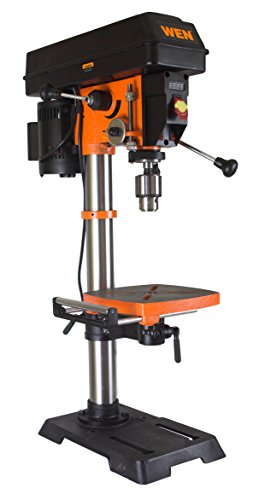 Top Pick
WEN 12" Variable Speed Benchtop Drill Press
Dial in exact chart RPM · ~$314
Check Price
Top Pick
WEN 12" Variable Speed Benchtop Drill Press
Dial in exact chart RPM · ~$314
Check Price
As an Amazon Associate, WorkshopCalc earns from qualifying purchases.
Drill Speed Chart for Wood (Twist Bits)
Wood tolerates a wide speed range. Use the high end for clean cuts in softwood and the low end for hardwood, large bits, and to reduce burning. Speeds in RPM.
| Bit Diameter | Softwood (Pine, Cedar) | Hardwood (Oak, Maple) |
|---|---|---|
| 1/16" – 1/8" | 3000–3800 | 3000–3800 |
| 3/16" | 3000 | 2500 |
| 1/4" | 3000 | 2000–2500 |
| 3/8" | 2000–2500 | 1500 |
| 1/2" | 1500–1800 | 1000–1500 |
| 5/8" | 1250 | 1000 |
| 3/4" | 1000–1250 | 750–1000 |
| 1" | 750–1000 | 500–750 |
Forstner & Spade Bits Run Slower
Large flat-bottoming bits remove a lot of material at once. Drop your speed: see the dedicated chart below or use our Drill Press Speed Calculator for any bit and material.
Forstner & Spade Bit Speed Chart
Wide bits need low RPM to clear chips and avoid scorching. These are recommended top speeds; slow down further for hardwoods and burn-prone woods like cherry and maple.
| Bit Diameter | Forstner Bit RPM | Spade Bit RPM |
|---|---|---|
| 1/4" – 1/2" | 1800–2400 | 2000 |
| 5/8" – 3/4" | 1200–1800 | 1500–2000 |
| 1" | 1000 | 1500 |
| 1-1/4" – 1-3/8" | 500–750 | 1000 |
| 1-1/2" – 2" | 500 | 700 |
| 2-1/8" – 3" | 250 | 500 |
| 3-1/8"+ | 250 | n/a |
Drill Speed Chart for Metal (HSS Twist Bits)
Metal is far less forgiving than wood, too fast and you burn the edge off the bit. Use cutting oil for steel and stainless. Speeds in RPM for high-speed-steel bits.
| Bit Diameter | Aluminum / Brass | Mild Steel | Stainless Steel | Cast Iron |
|---|---|---|---|---|
| 1/16" | 6000+ | 4500 | 2400 | 4000 |
| 1/8" | 6000 | 2400 | 1200 | 2000 |
| 3/16" | 4000 | 1600 | 800 | 1300 |
| 1/4" | 3000 | 1200 | 600 | 1000 |
| 3/8" | 2000 | 800 | 400 | 650 |
| 1/2" | 1500 | 600 | 300 | 500 |
| 5/8" | 1200 | 500 | 250 | 400 |
| 3/4" | 1000 | 400 | 200 | 325 |
| 1" | 750 | 300 | 150 | 250 |
Metal Drilling Tip
If the bit is squealing or smoking, you are too fast. Steel chips should come off in curls, not powder. Always center-punch metal first, use cutting oil on steel and stainless, and apply firm, steady pressure, let the bit cut rather than skating on the surface.
Drill Speed Chart for Plastic & Acrylic
Plastics melt if drilled too fast or with the wrong bit. Moderate speed, light pressure, and frequent chip clearing prevent gummed-up, cracked holes.
| Bit Diameter | Acrylic / Plexiglass | PVC / HDPE / Soft Plastic |
|---|---|---|
| 1/8" | 3000 | 3000 |
| 1/4" | 2000 | 2500 |
| 3/8" | 1500 | 2000 |
| 1/2" | 1000 | 1500 |
| 3/4" | 500–750 | 1000 |
| 1" | 500 | 750 |
Drill presses that hit these exact speeds
A variable-speed drill press lets you dial in the exact RPM from the charts above instead of settling for the nearest pulley step.
 Better Pick
JET JWDP-12 12" Benchtop Drill Press
Mechanical variable speed with digital RPM readout
~$636
Check Price on Amazon
Good Pick
WEN 12" Variable Speed Benchtop Drill Press
Cast iron, laser and LED, dial in exact chart RPM
~$314
Check Price on Amazon
Better Pick
JET JWDP-12 12" Benchtop Drill Press
Mechanical variable speed with digital RPM readout
~$636
Check Price on Amazon
Good Pick
WEN 12" Variable Speed Benchtop Drill Press
Cast iron, laser and LED, dial in exact chart RPM
~$314
Check Price on Amazon
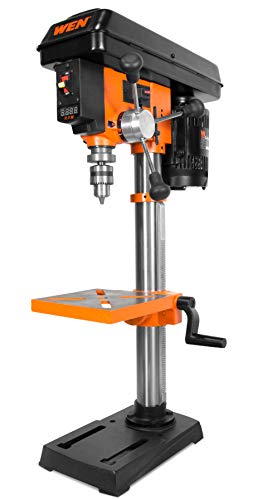 Budget Pick
WEN 10" Variable Speed Benchtop Drill Press
Variable speed on a budget
~$240
Check Price on Amazon
Budget Pick
WEN 10" Variable Speed Benchtop Drill Press
Variable speed on a budget
~$240
Check Price on Amazon
As an Amazon Associate, WorkshopCalc earns from qualifying purchases. Prices are approximate and can change.
The Drill Speed (RPM) Formula
Every number in the charts above comes from the surface-speed formula. Surface speed (SFM, surface feet per minute) is a property of the material; you solve for the RPM that keeps the cutting edge at that speed for a given bit diameter.
Imperial & Metric Formulas
RPM = (SFM × 3.82) ÷ Diameter (inches)
RPM = (1000 × surface speed in m/min) ÷ (π × Diameter in mm)
Example: mild steel (80 SFM) with a 1/4" bit → (80 × 3.82) ÷ 0.25 = 1222 RPM.
Recommended Surface Speeds (SFM) by Material
Use these standard SFM values for HSS bits in the formula above. Carbide bits can run 2–3× faster.
| Material | Surface Speed (SFM) | Surface Speed (m/min) |
|---|---|---|
| Softwood | 200–300 | 60–90 |
| Hardwood | 150–200 | 45–60 |
| Aluminum | 200–300 | 60–90 |
| Brass / Bronze | 150–300 | 45–90 |
| Cast Iron | 60–80 | 18–24 |
| Mild Steel | 70–90 | 21–27 |
| Stainless Steel | 40–50 | 12–15 |
| Acrylic / Plastic | 100–200 | 30–60 |
Get the Exact RPM for Any Bit
Plug in your bit size and material and our Drill Press Speed Calculator gives the precise RPM and nearest pulley setting.
Open Drill Press Speed CalculatorDrill Bits Worth Having
Quality bits hold their edge at the speeds in these charts.
DW1354 14-Piece Titanium Drill Bit Set
Best All-Around- Pilot Point tips start on contact without walking
- Titanium coating runs cooler at higher RPM
- Handles wood, plastic, and light metal drilling
- Labeled case for fast size selection
7-Piece Forstner Bit Set
Best for Clean Flat Holes- Clean flat-bottom holes for hinges and dowels
- Run at the lower speeds in the Forstner chart above
- Covers common 1/4" through 2" sizes
- Great paired with a drill press for accuracy
As an Amazon Associate, WorkshopCalc earns from qualifying purchases. This helps support our free calculators and guides.