Complete reference for hex key sizes in SAE and metric, which key fits socket head cap screws and set screws, SAE-to-metric conversions, and how to measure and choose the right Allen wrench.
A hex key (Allen wrench) drives the hexagonal socket found in cap screws, set screws, and countless pieces of furniture, bicycles, and machinery. This guide covers every common SAE and metric size, shows which key fits each socket head cap screw and set screw, explains why SAE and metric keys are not interchangeable, and helps you pick between L-key, T-handle, folding, and ball-end styles.
⚡ Quick Answer
"Hex key" and "Allen wrench" are the same tool, a hexagonal L- or T-shaped key measured across the flats. They come in SAE/inch sizes (0.028" up to 3/8") and metric (0.7mm up to 12mm). Common metric set sizes are 1.5, 2, 2.5, 3, 4, 5, 6, 8, and 10mm; common SAE are 1/16, 5/64, 3/32, 7/64, 1/8, 9/64, 5/32, 3/16, 7/32, 1/4, 5/16, and 3/8". The key size is determined by the socket-head screw, not the screw's thread diameter. See the chart below.
The set that covers this whole chart
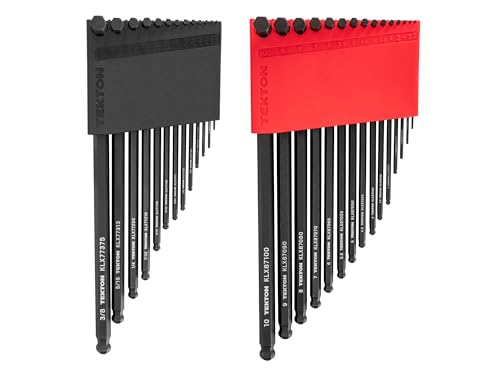
A quality hex and Torx set covers every size in the tables below and will not round out like bargain keys.
As an Amazon Associate, WorkshopCalc earns from qualifying purchases. Prices are approximate and can change.
Common Hex Key Sizes (SAE and Metric)
Hex keys are measured across the flats, the distance between two opposite flat faces of the hexagon, which is the same dimension as the socket in the fastener. The table below lists the common SAE (inch) sizes and metric (mm) sizes, with decimal-inch equivalents so you can compare the two systems directly.
SAE (inch) Size
Metric Size
Metric in Decimal Inches
1/16" (0.0625")
1.5mm
0.059"
5/64" (0.078")
2mm
0.079"
3/32" (0.094")
2.5mm
0.098"
7/64" (0.109")
3mm
0.118"
1/8" (0.125")
4mm
0.157"
9/64" (0.141")
5mm
0.197"
5/32" (0.156")
6mm
0.236"
3/16" (0.188")
8mm
0.315"
7/32" (0.219")
10mm
0.394"
1/4" (0.250")
n/a
n/a
5/16" (0.313")
n/a
n/a
3/8" (0.375")
n/a
n/a
Tools for this chart
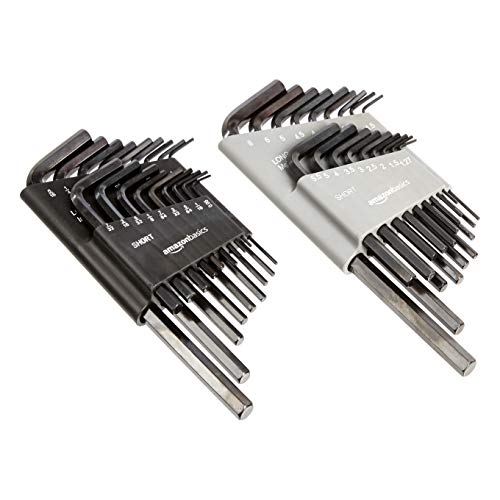
Hex key set, SAE and metricThe keys this chart is about, in both size systems.Amazon pick: Amazon Basics 36-Piece Hex Key Set, SAE and Metric; Grizzly does not sell this category
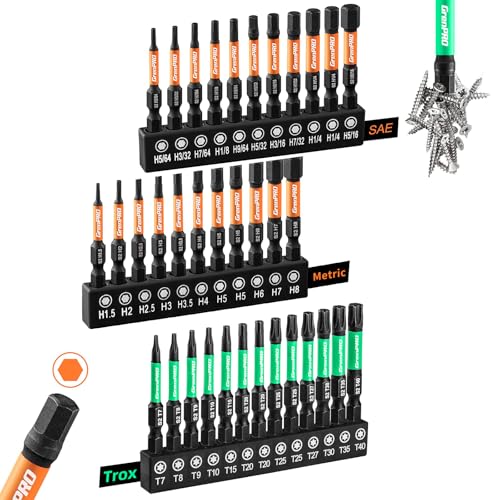
Hex-shank impact driver bitsQuick-release bits for driving screws and bolts with a power driver.Amazon pick: GRENPRO 35-Piece S2 Impact Bit Set; Grizzly pick: Grizzly PRO S2 Quick-Release Hex-Shank Impact Driver Bit Set, 23 pc
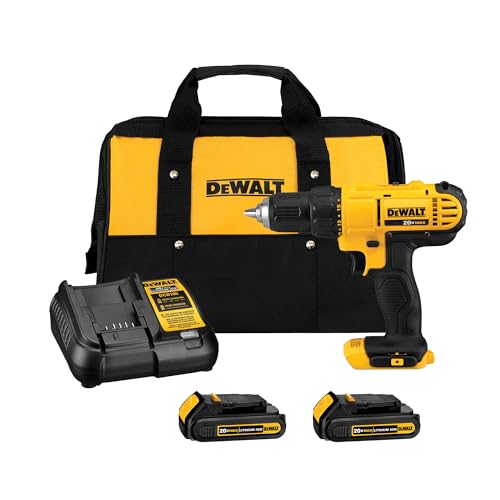
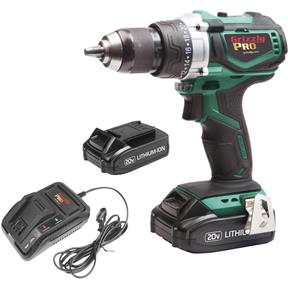
20V drill and driver kitA cordless kit that takes hex-shank bits.Amazon pick: DEWALT 20V Max XR Drill Driver Kit (DCD771C2); Grizzly pick: Grizzly PRO 20V Hammer Drill Kit with 2 Batteries and Charger
WorkshopCalc is an Amazon Associate and a Grizzly Industrial affiliate. We earn from qualifying purchases.
Reading the Chart
The SAE and metric columns are listed in ascending order, not as exact equivalents, each row simply places the two systems side by side. Use the decimal-inch column to see how close a given metric key is to an SAE size. The full smaller sizes (0.028", 0.035", 0.050", 0.7mm, 0.9mm, 1.27mm) appear on precision and electronics sets but are uncommon in general workshops.
The next thing most shops buy
Hex keys come with the machines. These are the machines.
Shopping for the person who uses this page? A proper hex key set or a mechanics tool set with every drive size is the gift that stops the hunt for the right size. Start with our gifts for the handyman or DIY dad, or see the best gifts for woodworkers; every pick is a specific stocked model, ranked from the big machines down to stocking stuffers.
Socket Head Cap Screw to Hex Key Size (Metric)
For standard metric socket head cap screws (DIN 912 / ISO 4762), the hex key size is fixed by the screw's socket, not its thread diameter. Use this chart to match the bolt size to the correct hex key.
Screw Size
Hex Key Size
M3
2.5mm
M4
3mm
M5
4mm
M6
5mm
M8
6mm
M10
8mm
M12
10mm
M14
12mm
M16
14mm
Button-Head and Low-Head Screws Differ
The chart above is for standard socket head cap screws. Button-head (ISO 7380) and low-head (DIN 7984) screws use a smaller hex socket, for example, an M6 button-head screw typically takes a 4mm key rather than 5mm. Always confirm against the specific screw if it is not a standard cap screw.
Socket Head Cap Screw to Hex Key Size (SAE)
Imperial (SAE) socket head cap screws follow the ASME/ANSI standard. As with metric, the hex key size is determined by the socket, not the thread diameter.
Screw Size
Hex Key Size
#4
3/32"
#6
7/64"
#8
9/64"
#10
5/32"
1/4"
3/16"
5/16"
1/4"
3/8"
5/16"
1/2"
3/8"
Set Screw to Hex Key Size
Socket set screws (grub screws) use a smaller hex socket than cap screws of the same thread size, because the socket has to fit within the screw's outside diameter. These are the common pairings.
Set Screw Size
Hex Key Size
M3
1.5mm
M4
2mm
M5
2.5mm
M6
3mm
M8
4mm
M10
5mm
M12
6mm
#8 (SAE)
5/64"
#10 (SAE)
3/32"
1/4" (SAE)
1/8"
5/16" (SAE)
5/32"
3/8" (SAE)
3/16"
Why Set Screws Use Smaller Keys
A set screw has no head, so the entire body is just the threaded diameter. The hex socket must be recessed inside that diameter, leaving room for the screw walls. That is why an M6 set screw uses a 3mm key while an M6 cap screw uses a 5mm key.
SAE vs Metric Hex Keys (Close But Not Interchangeable)
Several SAE and metric hex key sizes are close enough to tempt substitution, but using the wrong one is the fastest way to strip a fastener. The clearest example: a 3/16" key measures 0.1875" while a 5mm key measures 0.197": about 0.01" larger. A 5mm key will not fully seat in a 3/16" socket, and a 3/16" key will rattle loosely inside a 5mm socket. Under torque, that gap lets the key cam against the socket corners and round them out.
Near-Match Pair
SAE (decimal)
Metric (decimal)
Difference
5/64" vs 2mm
0.078"
0.079"
~0.001" (very close)
3/16" vs 5mm
0.188"
0.197"
~0.010" (strips easily)
1/4" vs 6mm
0.250"
0.236"
~0.014" (do not mix)
5/16" vs 8mm
0.313"
0.315"
~0.002" (close, still risky)
Best Practice
Always match the system to the fastener. If you do not know whether a screw is SAE or metric, try keys in ascending size and use the largest one that fully inserts with a snug fit and no wobble. A loose key plus high torque equals a rounded socket you will have to drill out.
L-Key vs T-Handle vs Folding vs Ball-End
Hex keys come in several physical formats. The size chart is identical across all of them, they differ only in handling, reach, and torque.
L-Key (Standard)
Classic bent hex rod, short and long arm
Long arm for reach, short arm for high leverage
Cheapest and most compact; sold in sets
Best all-around choice for occasional use
T-Handle
Hex shaft fixed to a perpendicular handle
Two-hand grip delivers high, even torque
Fast spinning for repetitive fastening
Favored in bike shops and assembly work
Folding (Multi-Tool)
Multiple keys pivot from a single handle
Pocketable; keys stay organized and clean
Handle adds leverage over a bare L-key
Great for bikes, furniture, and travel kits
Ball-End
Rounded tip enters the socket at an angle
Works up to ~25-30 degrees off-axis
Spin fast to start, then switch ends to finish
Use the straight end for final torque
Mix and Match
Many quality L-key sets have a ball end on the long arm and a straight (broached) end on the short arm, giving you reach and angle on one side and full-torque grip on the other. For heavy-duty work, keep a T-handle set in the matching sizes you use most.
How to Measure a Hex Key
If a hex key is unmarked or worn, you can identify its size in a couple of ways.
With Calipers
Measure across the flats (face to opposite face)
That dimension is the nominal size
Compare to the chart: e.g. 0.197" = 5mm
Do not measure point-to-point (that is larger)
By Trial Fit
Insert candidate keys into the socket
The correct key seats fully with no wobble
Too small = it spins; too large = it will not enter
Pick the largest key that fully inserts
Quick Tip
Across-the-flats is the standard measurement for all hex tooling, including hex keys, hex bolt heads, and hex stock. If your caliper reads a point-to-point distance, divide by about 1.155 to get the across-flats size.
Recommended Hex Key Sets
A good hex key set covers both SAE and metric in the common sizes and includes ball ends for reach. These are the formats worth owning. All links are affiliate links, we may earn a commission at no cost to you.
TEKTON
TEKTON Ball End Hex + Star L-Key Set, 41-Piece
Pro Upgrade
41 KeysSAE + Metric + TorxBall End
Covers every size on this chart, SAE, metric, and star
Ball ends work at up to 25-degree angles
Organized stand keeps every size in place
Lifetime warranty (under $100)
Hex Key
SAE + Metric Hex Key Set
Best Overall
Dual SystemBall-End Long ArmStorage Holder
Covers both SAE and metric common sizes
Ball ends reach screws at an angle
Color-coded or labeled holder keeps sizes sorted
One purchase handles nearly every fastener
Hex Key
Ball-End L-Key Set
Best for Reach
Ball + Straight EndsLong ArmChrome-Vanadium
Ball end enters sockets at up to ~25-30 degrees
Straight short-arm end for final torque
Long arms reach recessed fasteners
Ideal for awkward, blocked screw locations
Hex Key
T-Handle Hex Key Set
Best for Torque
T-Handle GripStand IncludedMetric or SAE
Two-hand grip delivers high, even torque
Fast spinning for repetitive assembly
Stand keeps sizes upright and visible
Workshop and bike-shop favorite
Hex Key
Folding Hex Key Set
Best Portable
Folding Multi-ToolPocketableSAE or Metric
All keys pivot from one compact handle
Handle adds leverage over a bare L-key
Keys stay organized, clean, and never lost
Perfect for bikes, furniture, and travel kits
As an Amazon Associate, WorkshopCalc earns from qualifying purchases. This helps support the site at no additional cost to you. We only recommend products we would use in our own workshops.
Updated 2026. A complete metric Allen key set runs from 1.5 mm to 10 mm, and a standard SAE set runs from 1/16 inch to 3/8 inch. The table lists each metric hex key size with its decimal inch equivalent and the screws it drives. A hex key always has six sides (a hexagonal cross section), and the size is the distance across the flats, not corner to corner.
Hex Key Size
In Decimal Inches
Typical Screw It Fits
0.7 mm
0.028"
M1.6 set screws, eyeglass and electronics screws
0.9 mm
0.035"
M2 set screws
1.3 mm
0.051"
M2.5 set screws
1.5 mm
0.059"
M3 set screws, M2 cap screws
2 mm
0.079"
M4 set screws, M2.5 cap screws
2.5 mm
0.098"
M3 cap screws, M5 set screws
3 mm
0.118"
M4 cap screws, M6 set screws
4 mm
0.157"
M5 cap screws, M8 set screws
5 mm
0.197"
M6 cap screws, M10 set screws
6 mm
0.236"
M8 cap screws
8 mm
0.315"
M10 cap screws
10 mm
0.394"
M12 cap screws
12 mm
0.472"
M14 cap screws
14 mm
0.551"
M16 cap screws
17 mm
0.669"
M20 cap screws
19 mm
0.748"
M24 cap screws
Frequently Asked Questions
Yes. "Hex key" and "Allen wrench" (or "Allen key") are different names for the same tool, a hexagonal L- or T-shaped key that drives a hex-socket fastener. "Allen" comes from the Allen Manufacturing Company, an early maker of the tool, and became a generic name. The size is measured across the flats of the hexagon, which matches the hex socket in the screw.
A standard M6 socket head cap screw takes a 5mm hex key. Note that the hex key size is set by the screw's socket, not the M6 thread diameter, so it does not match the bolt size. Some low-head or button-head M6 screws use a 4mm hex key, and M6 set screws typically use a 3mm hex key, so always check the specific screw type.
Not safely. Some SAE and metric sizes are close, for example, a 3/16" key is 0.1875" and a 5mm key is 0.197", a difference of about 0.01". Using the wrong one leaves a loose fit that can round out (strip) the socket or the key under torque. Always use the matching system. When in doubt, try the largest key that fully inserts without forcing.
Common metric hex key sizes are 1.5, 2, 2.5, 3, 4, 5, 6, 8, and 10mm. Common SAE (inch) sizes are 1/16, 5/64, 3/32, 7/64, 1/8, 9/64, 5/32, 3/16, 7/32, 1/4, 5/16, and 3/8 inch. A good general-purpose set in both systems covers nearly all household furniture, bicycle, and machinery fasteners you are likely to encounter.
A ball-end hex key has a rounded tip that lets you insert the key at an angle, up to about 25 to 30 degrees off-axis, to reach screws you cannot approach straight on. Use the ball end to start and spin fasteners quickly, then switch to the straight (broached) end for final tightening, because the ball end contacts less of the socket and can round it out under high torque.
A hex key (Allen wrench) has six sides, because the shaft is a hexagon. It drives a hexagonal socket in the screw head and makes contact on six flat faces, which is why it is rated by the distance across the flats.
An M3 set screw takes a 1.5 mm hex key. An M3 socket head cap screw takes a larger 2.5 mm hex key, so check whether the screw is a set screw or a cap screw before you pick the key.
A 5/64 inch hex key fits a #8 SAE set screw. Its closest metric match is a 2 mm hex key (M4 set screw), and the two are within about 0.001 inch, but they are not the same size.
Standard metric hex key sizes are 1.5, 2, 2.5, 3, 4, 5, 6, 8 and 10 mm in a typical set, with 12, 14, 17 and 19 mm sold separately for large cap screws. The 4 mm, 5 mm and 6 mm keys are the ones used most often.