How to stop planer snipe
Snipe allowance: how long to cut your rough boards
Measure the snipe on a test board from your planer (often 2 to 3 inches at each end on a benchtop machine), then enter your finished length.
The formula. Rough length = finished length + 2 x (snipe per end + trim per end). A 36 inch part with 3 inches of snipe and a half inch of trim at each end needs a 43 inch rough board. Butting boards end to end or running sacrificial leaders removes the snipe term for all but the first and last board.
Causes and fixes
| Where the snipe is | Likely cause | Fix |
|---|---|---|
| Leading end only | Board tips up as it enters, before the outfeed roller grips | Raise the trailing end slightly on entry; level the infeed table with the bed |
| Trailing end only | Board drops as it leaves the infeed roller | Support the outfeed end level; lift the leading end slightly as it exits |
| Both ends | Cutterhead carriage moves when pressure changes | Engage the head lock if the planer has one; take a light last pass |
| Long boards only | Board weight levers the ends off the bed | Roller stands on both sides at bed height |
| Worse than before | Dull knives or worn, dirty feed rollers | Turn or replace knives; clean the rollers and bed, wax the bed |
Step by step
- Set the tables. Benchtop planers have fold-down infeed and outfeed tables. Level them with the bed, or set the outer ends very slightly high, using a straightedge across all three surfaces.
- Support long stock. A board longer than the tables needs a roller stand on each side set to bed height, so its weight never levers the end up into the knives.
- Lock the head. If your planer has a cutterhead lock, engage it after setting depth and before the final pass.
- Butt boards end to end. Feed the next board right behind the last, so the rollers never let go of an end. A scrap of the same thickness at the start and finish catches the snipe.
- Finish light. Take a final pass of 1/32 inch or less. Less cutting force means less movement.
- Keep knives sharp and rollers clean. Pitch on the feed rollers lets the board slip and rock.
Planers throw a large volume of chips, and a clogged chute makes the board ride unevenly. Hook the planer to a collector sized with our dust collector calculator. For whether you need both machines, read planer vs jointer; a planer copies the bottom face, so a cupped board stays cupped unless it is jointed flat first.
Tools that help
Roller stands fix the most common cause on long stock. If your planer has no head lock and snipe is constant, a planer with one, or a stationary machine with a heavier carriage, is the long-term fix. For the two planers head to head, see Grizzly G1021Z vs DeWalt DW735X and the DW735X review; more models are in the best thickness planers.
DEWALT DW735X 13 Inch Two-Speed Thickness Planer
If you need a benchtop planer: 13 inch width, two speeds and three knives per the listing.
See on Amazon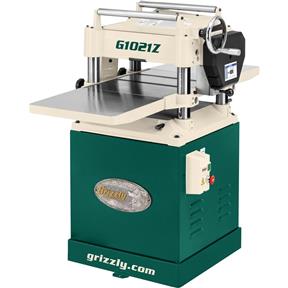
Grizzly G1021Z 15 in. 3 HP Planer with Cabinet Stand
If you are moving to a stationary planer: 15 inch width, 3 HP on 230V per Grizzly.
Buy direct at GrizzlySHALL Heavy-Duty Folding Roller Stands, 2 Pack
If your long boards droop off the tables: one stand on each side, 27.8 to 43 inch height per the listing.
See on AmazonBORA Adjustable Conveyor Roller Stand
If you want a multi-roller conveyor top for long, heavy stock.
See on AmazonSkip this if
Your boards are short offcuts that you will cut into small parts anyway: plan them oversize and cut the ends away. Also skip new equipment if your snipe started recently, since dull knives and dirty rollers are cheaper to fix than a new planer.
Related reading
Frequently asked questions
What causes planer snipe?
Snipe happens when the board is held by only one feed roller, at the start and end of the pass. The unsupported end can tip up into the cutterhead, or the head can lift and drop, leaving a deeper cut a few inches long at one or both ends.
Can you completely eliminate snipe?
On most benchtop planers you can reduce it to a trace but rarely to zero every time. Support at both tables, a head lock if the planer has one, light final passes and butting boards end to end get close. Cutting off the sniped ends is the dependable backup.
Should I lift the board while planing to stop snipe?
Lifting the trailing end slightly as the board enters and the leading end as it leaves helps on many benchtop planers, because it keeps the board pressed flat against the bed under the cutterhead. Keep hands well clear of the infeed opening and follow your planer manual.
Do sacrificial boards stop planer snipe?
Yes. Feeding a scrap of the same thickness right before and after the workpiece, or butting several boards end to end, means the snipe lands on the scrap instead of your board.
Keep hands clear of the infeed and outfeed openings, wear hearing and eye protection, and follow your planer's manual.
Disclosure: WorkshopCalc is an Amazon Associate and a Grizzly Industrial affiliate. We earn from qualifying purchases made through the buttons on this page, at no extra cost to you. Prices are not shown because they change often.