What size air compressor do I need for an impact wrench?
Size the compressor for your impact wrench
Compressors matched to your result
The formula. Required CFM = (wrench CFM + second tool CFM) x usage margin, rounded up. Margins are 1.25 for light use, 1.5 for medium and 2.0 for heavy, the same duty-cycle margins our air compressor CFM calculator uses. Tank guide: up to 5 CFM, 20 to 30 gallons; up to 10, 30 to 60 gallons; up to 15, 60 to 80 gallons; above that, 80 gallons or two-stage. Horsepower is a rough guide at about 3.5 CFM per HP. Tool figures come from our air tool CFM chart; your wrench's manual has the exact number, so use it if it differs.
Impact wrench air needs at a glance
| Wrench and use | Tool CFM at 90 PSI | CFM to buy (with margin) | Tank |
|---|---|---|---|
| 1/2 inch, light | 5 | 7 | 30 to 60 gal |
| 1/2 inch, medium | 5 | 8 | 30 to 60 gal |
| 1/2 inch, heavy | 5 | 10 | 30 to 60 gal |
| 3/4 inch, medium | 7 | 11 | 60 to 80 gal |
| 3/4 inch, heavy | 7 | 14 | 60 to 80 gal |
Why the CFM number matters more than the tank
An impact wrench hammers in bursts, and each burst pulls air faster than most small pumps can replace it. The tank is a buffer: it lets you zip off a few lug nuts before the pressure falls, then the pump has to catch up. If the pump's CFM at 90 PSI is below what the wrench uses, every long session ends with the wrench slowing down while you wait for the tank to refill. That is why the margin matters. A compressor that lists exactly 5 CFM will run a 1/2 inch wrench for tire rotations, but it will run constantly on a stubborn axle nut or a full brake job.
Read listings carefully. CFM at 90 PSI is the figure to compare; CFM at 40 PSI is always higher and is not what an impact wrench sees. Horsepower and peak PSI are not substitutes for CFM. Oil-free units are quieter to own and need less upkeep, while belt-drive oil-lubed pumps tend to tolerate long run times better. Larger two-stage compressors run on 240V, which needs a dedicated circuit installed by a licensed electrician; local code governs.
Get the air to the wrench
- Use a 3/8 inch hose and 3/8 inch couplers for a 1/2 inch wrench; 1/4 inch fittings choke it.
- Set the regulator to 90 PSI with the trigger pulled, not at rest.
- Oil the wrench before each session if the manual says so, and drain the tank after use.
- Use impact-rated sockets only. See the socket size chart for sizes.
Compressors by result
Two compressors cover occasional 1/2 inch work on 120V or a small circuit, and two stationary units cover daily or 3/4 inch work. Specs below come from each listing or Grizzly's product page. For more models, see the best air compressors, and for the two quiet 20 gallon units head to head, read Grizzly T32337 vs California Air Tools 20020AD.
DEWALT DXCM251 25-Gallon Vertical Portable Air Compressor
25 gallon, 2 HP, oil lubed, 6.2 SCFM at 90 PSI per the listing.
See on Amazon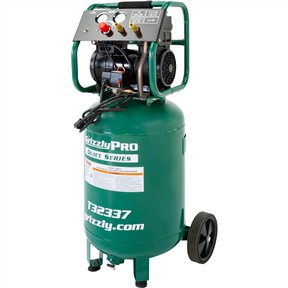
Grizzly PRO T32337 20 Gallon Oil-Free Quiet Series Air Compressor
20 gallon, 120V, Grizzly lists 5.6 SCFM at 90 PSI.
Buy direct at GrizzlyDEWALT 60 Gallon 5 HP Two-Stage Stationary Air Compressor
60 gallon, two-stage, 5 HP, 230V per the listing.
See on AmazonIngersoll Rand 2475N7.5 7.5 HP Two-Stage Air Compressor
80 gallon, two-stage, up to 24.3 CFM at 90 PSI per the listing.
See on AmazonSkip this if
You only need to break loose lug nuts a few times a year and own no other air tools. A cordless 1/2 inch impact wrench does that without a compressor, hose or circuit; see the best cordless impact wrenches. Also skip the small units above if you plan to add a DA sander or spray gun later: size for those with the full air compressor calculator instead.
Related reading
Frequently asked questions
Will a pancake compressor run a 1/2 inch impact wrench?
For a few short bursts, yes, but small pancake units deliver well under the 5 CFM at 90 PSI a 1/2 inch impact wrench averages, so pressure falls fast and the wrench loses torque. Use one only for tire changes with long pauses; for regular lug nut or suspension work, step up to a compressor that lists at least 5 CFM at 90 PSI.
Is a 20 gallon compressor big enough for an impact wrench?
It can be, if its listed CFM at 90 PSI is at least the wrench's 5 CFM and you work in bursts. The tank only buys time between pump cycles; the pump's CFM is what keeps up. The site's calculator suggests 30 to 60 gallons once you add a working margin.
What PSI does an impact wrench need?
Most air impact wrenches are rated at 90 PSI at the tool. Set the regulator for 90 PSI with the trigger pulled, because hose length and quick couplers drop pressure between the tank and the wrench.
Does hose size matter for an impact wrench?
Yes. A long 1/4 inch hose starves a 1/2 inch impact wrench. A 3/8 inch hose with 3/8 inch couplers keeps more of the pressure at the tool; keep the run as short as practical.
Should I just buy a cordless impact wrench instead?
If you do not already own a compressor and only need lug nuts and occasional bolts, a cordless 1/2 inch impact wrench avoids the compressor entirely. See the best cordless impact wrenches guide on this site. An air setup makes more sense when you also run sanders, grinders or spray guns.
Disclosure: WorkshopCalc is an Amazon Associate and a Grizzly Industrial affiliate. We earn from qualifying purchases made through the buttons on this page, at no extra cost to you. Prices are not shown because they change often.